

Wearable Payment Market (2026-2032)
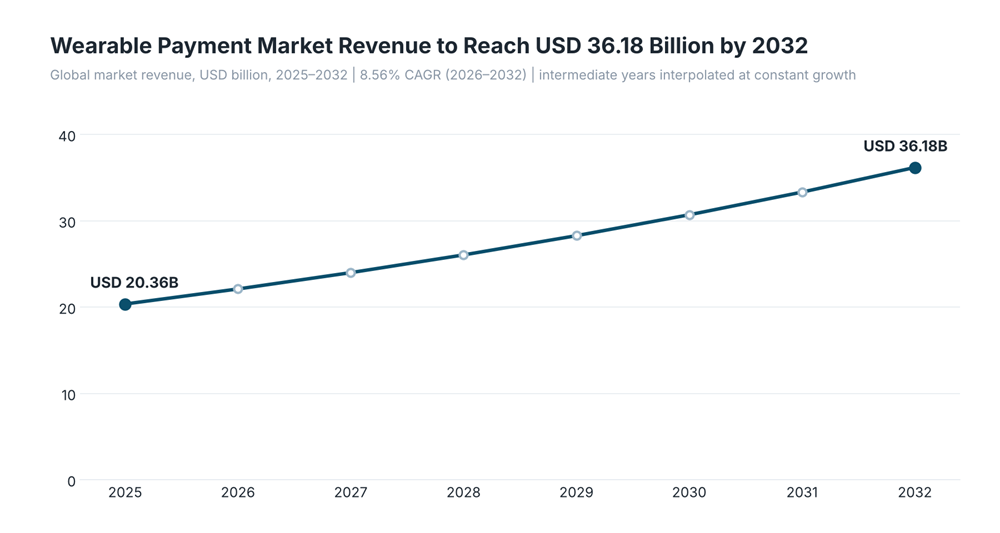
The Global Wearable Payment Market was valued at USD 20.36 billion in 2025 and is projected to reach USD 36.18 billion by 2032, expanding at a CAGR of 8.56% during 2026-2032.



Quick Enquiry
How Are Smartwatch Sales, Contactless Payment Adoption, and Wearable Hardware Innovation Driving the Global Wearable Payment Market?
The Global Wearable Payment Market was valued at USD 20.36 billion in 2025 and is projected to reach USD 36.18 billion by 2032, expanding at a CAGR of 8.56% during 2026–2032, according to MarketsandStats. Global sales reached an estimated 76.31 million payment-enabled wearable devices in 2025 and are projected to reach approximately 135.6 million units by 2032, assuming broadly stable average hardware prices over the forecast period. Smartwatches accounted for approximately 97.8% of hardware revenue, supported by premium models from Apple, Samsung, Huawei, and Garmin. Payment-enabled fitness bands, smart rings, bracelets, and conventional watches represented the remaining hardware demand, with revenue measured through device sales rather than payment transaction value.
According to Omdia, global wearable-band shipments exceeded 200 million units in 2025, increasing 6% year on year. Xiaomi led worldwide shipments with an 18% share, followed by Apple at 17%, Huawei at 16%, Samsung at 9%, and Garmin at 5%. These shares represent the broader wearable industry, including devices without payment functionality. The scale of these manufacturers and the higher selling prices of premium smartwatches reinforce their importance to payment-enabled hardware revenue.
Contactless payment adoption is creating favorable conditions for wearable hardware sales. According to the S&P Global Market Intelligence 451 Research Consumer Fintech Global Survey (2024), conducted with Discover Network, 60% of surveyed consumers preferred contactless payment methods, while 61% had used a digital wallet within the preceding 90 days. Its 2025 Global Merchant Survey found that 66% of merchants considered digital wallets highly important, while 55% viewed payments as a strategic priority. Growing contactless payment usage gives smartwatch and payment-accessory manufacturers greater opportunities to expand NFC-enabled hardware sales.
Payment rings and bracelets offer a smaller but distinct hardware opportunity, particularly across hospitality, transit, and entertainment. Discover Global Network identifies payment-enabled accessories that combine contactless purchases with access credentials and loyalty services, creating additional revenue opportunities for specialist manufacturers and venue operators.
United States Wearable Payment Market: Premium Smartwatch Sales Support Revenue Leadership
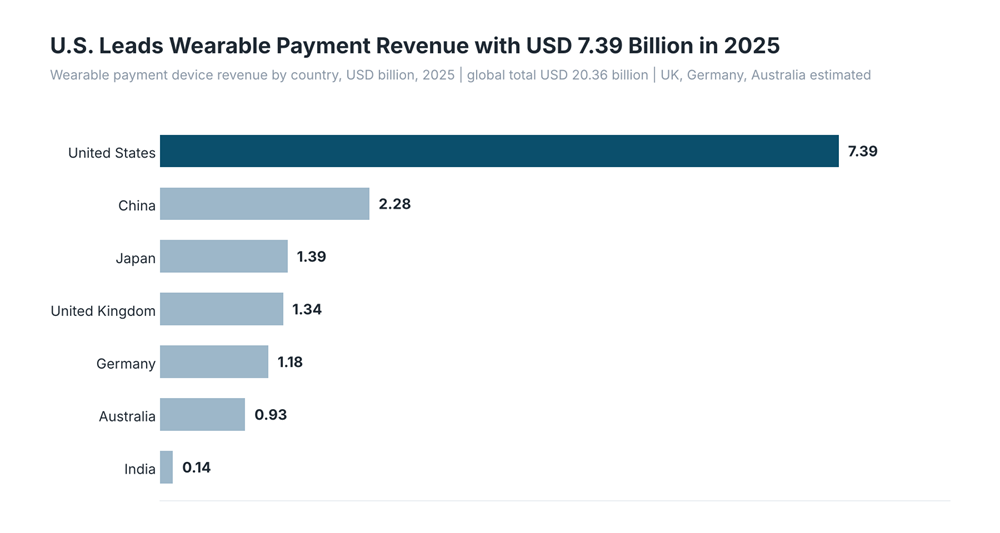
The United States Wearable Payment Market was valued at USD 7.39 billion in 2025 and is projected to reach USD 13.11 billion by 2032, expanding at a CAGR of 8.52% during 2026–2032. The country accounted for approximately 36.3% of global revenue in 2025, supported by premium smartwatch sales from Apple, Garmin, and Samsung. Higher average selling prices and recurring smartwatch upgrades contribute significantly to the country's hardware revenue.
According to the Federal Reserve's 2025 Diary of Consumer Payment Choice, U.S. consumers made an average of 11 payments per month using mobile phones in 2024, compared with four in 2018, reflecting growing use of device-based payments. In September 2025, Apple introduced the Watch SE 3 at a starting price of USD 249, alongside the Series 11 and Ultra 3. Apple's range of payment-capable watches across different price categories strengthens its position in the U.S. market, where premium hardware sales and replacement demand remain important sources of revenue.
China Wearable Payment Market: Domestic Manufacturers Drive Volume and Pricing Competition
The China Wearable Payment Market was valued at approximately USD 2.28 billion in 2025 and is projected to reach USD 4.04 billion by 2032, growing at a CAGR of 8.56%. China represents the second-largest country market and an important center for wearable device manufacturing, product development, and consumer electronics distribution.
According to Counterpoint Research, worldwide smartwatch shipments grew 4% in 2025 after declining in 2024. China was a major contributor to this recovery, supported by stronger shipments from Huawei, Xiaomi, and Imoo. Apple's renewed product portfolio also contributed to global smartwatch growth.
Huawei and Xiaomi provide China with a competitive advantage in affordable and mid-priced wearable hardware. Their manufacturing scale and domestic distribution networks allow them to serve a wider range of consumer budgets than premium-focused manufacturers. However, higher shipment volumes do not necessarily translate into equivalent revenue shares because realized selling prices vary considerably across product categories.
The development of China's wearable payment market also depends on compatibility with domestic payment ecosystems. Manufacturers capable of supporting locally accepted payment methods have a stronger commercial position than suppliers offering NFC hardware without usable payment functionality. Competitive pressure from lower-cost domestic brands is likely to remain an important factor influencing selling prices through 2032.
United Kingdom Wearable Payment Market: Established Contactless Infrastructure Creates Opportunities for Payment Rings and Watches
The United Kingdom Wearable Payment Market was estimated at USD 1.34 billion in 2025 and is projected to reach USD 2.38 billion by 2032, expanding at a CAGR of 8.57%. Its mature contactless payment environment provides favorable conditions for both premium smartwatches and dedicated payment accessories.
According to UK Finance, the country recorded 19.2 billion contactless payments in 2025, accounting for 39% of all payment transactions. Nearly two-thirds of the population had registered for a mobile wallet, demonstrating the established role of digital payment systems in everyday consumer spending. These statistics include physical cards and mobile devices rather than exclusively wearable payments.
The country's established contactless payment infrastructure supports demand for payment rings and bracelets, allowing specialist manufacturers to target consumers seeking affordable, compact alternatives to smartwatches. Adoption depends on compatibility with supported banks and payment networks.
Japan Wearable Payment Market: Transit Applications Support Everyday Device Utility
The Japan Wearable Payment Market was valued at approximately USD 1.39 billion in 2025 and is projected to reach USD 2.48 billion by 2032, registering a CAGR of 8.61%.
Japan represents an important market because wearable payments can be integrated into frequent consumer activities, particularly transportation and retail purchases. Compatible smartwatch payment services can use established transit payment systems, giving wearable hardware practical value beyond general contactless shopping.
Apple competes in Japan’s premium smartwatch segment, while domestic brands such as EVERING target demand for contactless payment rings. Established transit and retail payment networks create opportunities for both categories, with hardware revenue growth tied to new device purchases, replacement demand, and wider payment compatibility.
Germany and Australia: Mature Digital Payment Environments Support Hardware Adoption
The Germany Wearable Payment Market was estimated at USD 1.18 billion in 2025 and is projected to reach USD 2.10 billion by 2032, expanding at a CAGR of 8.61%. Germany combines demand for premium smartwatches with an established specialist payment-accessory ecosystem.
According to the Deutsche Bundesbank, cashless payments accounted for 55% of recorded everyday purchases in 2025, compared with 45% settled in cash. Mobile payment methods represented approximately 10% of transactions, an increase of four percentage points compared with 2023. These figures demonstrate changing payment behavior, although they do not isolate transactions made through wearable devices.
Germany also benefits from the presence of specialist payment-accessory manufacturers such as PAGOPACE. These suppliers compete in a different segment from premium smartwatch brands, focusing on consumers interested in payment functionality without a conventional smartwatch interface.
The Australia Wearable Payment Market was estimated at USD 928 million in 2025 and is projected to reach USD 1.65 billion by 2032, growing at a CAGR of 8.55%. According to the Reserve Bank of Australia, device-based payments accounted for approximately 40% of in-person card payments in 2025, compared with 31% in 2022. The survey also found that 43% of consumers had used a mobile device for contactless payment during the survey period. While phones account for much of this activity, widespread familiarity with device-based payments provides a favorable environment for compatible watches and payment accessories.
India Wearable Payment Market: Expanding Payment Compatibility Creates an Emerging Hardware Opportunity
The India Wearable Payment Market was estimated at approximately USD 142 million in 2025 and is projected to reach USD 253 million by 2032, expanding at a CAGR of 8.58%. The market remains relatively small under the payment-eligible hardware definition because many affordable smartwatches sold in India do not support activated contactless card payments.
A significant development occurred on September 30, 2026, when Apple introduced Apple Pay in India with initial support for eligible Axis Bank Visa and Mastercard credit cards. According to Apple's official announcement, the service supports compatible Apple Watches and can be used at participating NFC payment terminals. Apple also announced relationships with payment service providers, including Razorpay, Pine Labs, Paytm, and other companies serving Indian merchants.
Apple Pay's entry into India expands opportunities for premium payment-enabled smartwatches, although widespread UPI usage and strong demand for affordable wearables continue to shape consumer preferences. Wider banking partnerships and the availability of lower-priced NFC-enabled devices could help manufacturers reach a broader customer base.
Smartwatches Dominate Market Revenue as Premium Hardware Maintains Pricing Power
The smartwatch segment accounted for approximately USD 19.91 billion in 2025 and is projected to reach USD 35.24 billion by 2032, expanding at a CAGR of 8.50%. Smartwatches represented approximately 97.8% of total wearable payment hardware revenue, reflecting both their higher ASPs and their established position in consumer electronics.
Apple, Samsung, Huawei, Garmin, and Xiaomi dominate the competitive discussion because they have established hardware portfolios and distribution networks. Their products are purchased for a combination of functions, allowing payment capability to contribute to the overall value proposition rather than carrying the entire commercial justification for the device.
Premium smartwatch models from Apple, Samsung, and Garmin generate higher revenue per device, while affordable offerings from Huawei and Xiaomi compete primarily on sales volume. Differences in selling prices and product landscape continue to influence manufacturer revenue shares across the wearable payment market.
Fitness Bands Compete on Affordability While Payment Rings Record Faster Growth
Payment-enabled fitness bands generated approximately USD 344.39 million in 2025 and are projected to reach USD 650.06 million by 2032, growing at 9.50% annually. These devices provide a lower-priced alternative to premium smartwatches, particularly for consumers who prioritize compact designs and basic wearable functionality. However, many affordable fitness bands do not support card payments, making regional payment compatibility an important limitation.
The smart payment-ring segment was valued at approximately USD 38.40 million in 2025 and is projected to reach USD 154.47 million by 2032, expanding at a CAGR of 22.00%. The segment's higher percentage growth reflects its smaller starting base and the potential for payment-focused products to reach consumers who do not want another screen-based device.
Dedicated payment-ring manufacturers such as Tapster, PAGOPACE, and EVERING are expanding their presence through compact NFC-enabled devices, with banking partnerships and payment compatibility playing a central role in market competition.
Payment Bracelets and Conventional Watches Address Specialist Consumer Demand
Payment bracelets and wristbands were valued at USD 25.64 million in 2025 and are projected to reach USD 64.16 million by 2032, growing at a CAGR of 14.00%. Demand is concentrated in hospitality, entertainment venues, and lifestyle accessories, where affordable NFC-enabled wristbands support convenient cashless transactions.
Payment-enabled conventional watches accounted for USD 48.02 million in 2025 and are projected to reach USD 69.86 million by 2032, expanding at a CAGR of 5.50%. Established watchmakers such as Swatch and Mondaine offer contactless payment functionality in traditional watch designs, targeting consumers who prefer conventional timepieces over smartwatches.
Competitive Landscape: Apple Leads Revenue While Huawei, Samsung, Garmin, and Xiaomi Compete Across Distinct Price Segments
Apple led the Global Wearable Payment Market with an estimated USD 13.16 billion in hardware revenue in 2025, followed by Samsung at USD 2.32 billion, Huawei at USD 1.62 billion, Garmin at USD 1.16 billion, and Xiaomi at USD 483 million, according to MarketsandStats estimates. Apple's premium smartwatch pricing and established Apple Pay ecosystem support its leading revenue position. Samsung competes through its Galaxy Watch portfolio, while Huawei and Xiaomi maintain strong positions in China through broader price ranges and domestic distribution. Garmin focuses on premium sports and outdoor smartwatches with Garmin Pay functionality.
According to Garmin's fiscal 2025 results, the company generated USD 7.25 billion in annual revenue, growing 15% year on year, and shipped more than 20 million products across its businesses. Its premium fitness and outdoor portfolio strengthens its presence in higher-priced wearable categories, while Samsung, Huawei, and Xiaomi face greater competition across mainstream smartwatch price segments.
Specialist Payment Wearables: Banking Partnerships Influence Competition More Than Manufacturing Scale
PAGOPACE, Tapster, EVERING, Swatch, and Mondaine are expanding the market for NFC-enabled payment rings, bracelets, and conventional watches, targeting consumers seeking compact alternatives to smartwatches. According to Fidesmo, its payment network supports more than 230 card issuers across over 40 countries and over 20 participating OEM brands, including Tapster, PAGOPACE, and Mondaine. Germany, Austria, Switzerland, and the Nordic countries are important markets for these accessories. Wider banking compatibility enables specialist manufacturers to expand distribution across multiple countries, while differences in issuer support continue to influence market penetration.
Analyst Commentary
Banking compatibility remains a key competitive factor in the wearable payment hardware market. Payment rings and bracelets often support a limited selection of card issuers, restricting their addressable customer base even in countries with widespread contactless acceptance. Specialist manufacturers such as Tapster and PAGOPACE depend on payment-enablement partners to broaden card support, making issuer coverage an important factor in retail distribution, device activation, and competition with established smartwatch brands.