

US Events Industry Market (2026-2032)
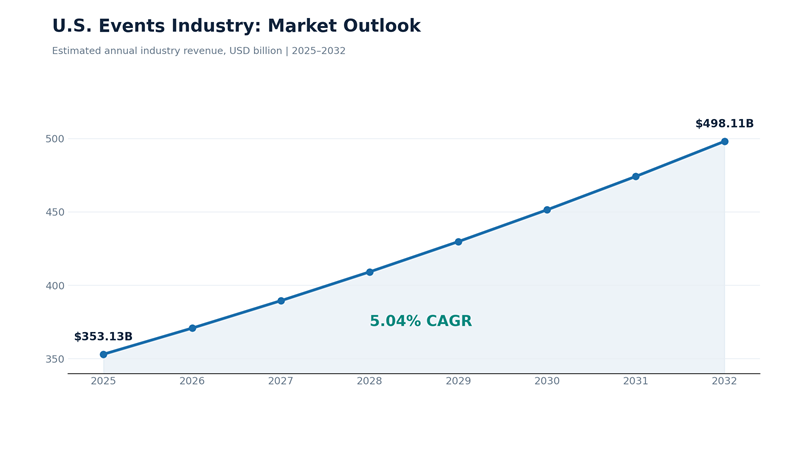
The United States Events Industry was valued at approximately USD 353.13 billion in 2025 and is projected to reach USD 498.11 billion by 2032, expanding at a CAGR of 5.04% during 2026-2032.



Quick Enquiry
United States Events Industry to Reach USD 498.11 Billion by 2032 as Corporate Gatherings, Live Entertainment, and Major Event Destinations Drive Spending
The United States Events Industry Market was valued at approximately USD 353.13 billion in 2025 and is projected to reach USD 498.11 billion by 2032, expanding at a CAGR of 5.04% during 2026–2032, according to MarketsandStats. Industry growth is supported by rising expenditure on corporate conferences, trade exhibitions, live entertainment, professional sports, and private celebrations. Increasing investment in convention facilities, premium event experiences, and large-scale productions is creating additional business opportunities for event organizers, venue operators, caterers, and specialist service providers.
Approximately 8.9 million commercially organized events were estimated to have taken place across the United States in 2025, with annual activity projected to reach 10.75 million by 2032. Corporate meetings and conferences account for the largest share of industry revenue, supported by recurring business gatherings and professional event contracts. Weddings and private celebrations contribute substantial event volumes and provide regular business for local venues, planners, and catering companies. Major concerts, sporting competitions, and national exhibitions generate higher spending per event through ticket sales, sponsorships, premium hospitality, and technical production.
The industry's commercial activity is particularly strong in California, Texas, New York, and Florida, where large corporate markets, entertainment venues, convention facilities, and substantial local populations support year-round events. Las Vegas, Orlando, Chicago, Atlanta, and Nashville also attract major conferences, exhibitions, concerts, and sporting events, bringing substantial business to venues and event-service companies. Competition remains fragmented, with large promoters and national organizers operating alongside thousands of regional planners, production specialists, and independent service providers. Growing investment in event infrastructure and competition among major destinations are expected to influence where organizers allocate their budgets and where event companies secure new contracts.
Which Event Types Account for the Largest Share of Industry Revenue?
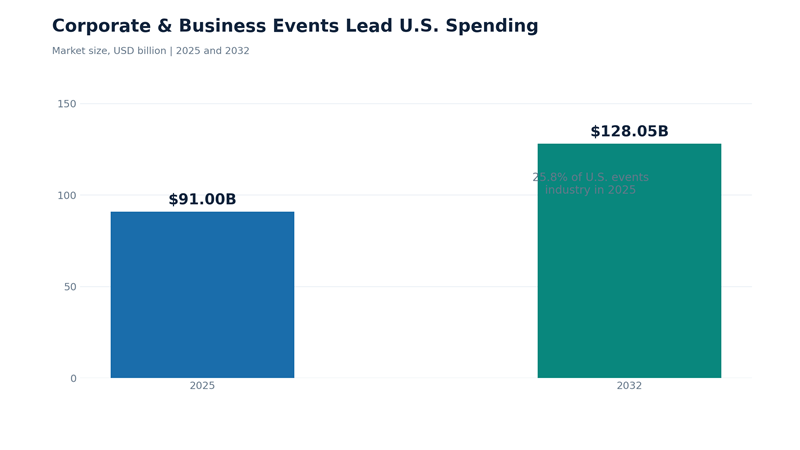
Corporate & Business Events represented the largest category, generating approximately USD 91 billion in 2025, equivalent to 25.8% of national revenue. The category is projected to reach USD 128.05 billion by 2032, growing at a CAGR of 5.0%. Corporate meetings, conferences, product launches, incentive events, networking programs, and professional gatherings account for recurring expenditure on venues, production, catering, registration, and event management. Large corporate organizations and professional associations create multi-year opportunities for convention facilities, hotels, audiovisual suppliers, and specialist event agencies.
Social & Personal Events accounted for approximately USD 86.16 billion in 2025, representing 24.4% of the market, and are projected to reach USD 114.92 billion by 2032, expanding at a 4.2% CAGR. Weddings remain the largest identifiable source of expenditure. The Wedding Report estimates that the United States hosted approximately 2.01 million weddings in 2025, generating USD 66.16 billion in spending. Birthdays, anniversaries, receptions, and private celebrations contribute additional activity across banquet facilities, catering, decoration, photography, entertainment, and planning services. The category remains highly fragmented, with local businesses capturing a substantial portion of expenditure.
Sports & Esports Events generated an estimated USD 65 billion in 2025, equivalent to 18.4% of industry revenue, and are projected to reach USD 98.38 billion by 2032, recording the fastest category growth at 6.1%. Professional leagues, collegiate competitions, amateur tournaments, motorsports, and esports contribute ticketing, sponsorship, hospitality, venue, and production revenue. U.S. consumer expenditure on spectator-sports admissions reached approximately USD 43.51 billion in 2025, providing a substantial commercial base for sporting-event operators. Premium seating, hospitality packages, and major tournament production create additional opportunities beyond general admission.
Music & Live Entertainment contributed approximately USD 50.97 billion in 2025, accounting for 14.4% of the market, and is projected to reach USD 73.65 billion by 2032 at a CAGR of 5.4%. Concerts, theater, comedy, live tours, and other performances support spending on admissions, staging, sponsorships, venues, and technical services. Live Nation Entertainment reported USD 20.9 billion in global Concerts revenue during 2025, with approximately 159 million attendees across 55,000 shows worldwide. Large touring productions and established entertainment venues remain important sources of spending on audio, lighting, video, staffing, and premium audience experiences.
Trade Shows & Exhibitions represented approximately USD 25 billion in 2025, or 7.1% of the industry, and are projected to reach USD 34.71 billion by 2032, expanding at a 4.8% CAGR. B2B exhibitions, consumer shows, and industry expos generate expenditure through booth rentals, registration, stand construction, sponsorship, logistics, and exhibition services. The Center for Exhibition Industry Research monitors exhibition revenue, attendance, exhibitors, and exhibition space across 14 U.S. industry sectors. Established exhibitions remain commercially valuable because repeat exhibitors and recurring professional audiences support long-term organizer and supplier relationships.
Festivals & Cultural Events contributed approximately USD 20 billion in 2025, reaching a projected USD 28.90 billion by 2032 at a 5.4% CAGR. Music festivals, state fairs, food festivals, art exhibitions, and heritage celebrations generate revenue through ticketing, vendor participation, sponsorship, concessions, production, and temporary event infrastructure. Major destination festivals create concentrated spending for promoters and service contractors, while local and regional festivals support a broader network of small businesses.
Government & Institutional Events represented approximately USD 8 billion in 2025, with revenue projected to reach USD 9.97 billion by 2032, growing at a 3.2% CAGR. Government conferences, official ceremonies, academic gatherings, and institutional meetings create recurring opportunities for convention venues, event agencies, catering companies, and audiovisual suppliers. Charity & Community Events accounted for approximately USD 7 billion in 2025, increasing to USD 9.53 billion by 2032 at a 4.5% CAGR. Fundraising galas, charity runs, auctions, and community programs generate commercial spending on venues, production, staffing, and event services, while charitable donations themselves remain outside industry revenue.
United States Events Industry Market: Revenue Growth Opportunities and Commercial Value Across Major Event Categories (2025–2032)
United States Events Industry Market: Revenue Growth Opportunities and Commercial Value Across Major Event Categories (2025–2032)
| Event Category | 2025 Market Value | Additional Annual Revenue by 2032 | Where Companies Capture Revenue |
|---|---|---|---|
| Corporate & Business Events | USD 91.00 Billion | USD 37.05 Billion | Multi-year corporate contracts, conference production, convention venues, and event management |
| Social & Personal Events | USD 86.16 Billion | USD 28.76 Billion | Wedding venues, premium catering, decoration, photography, and private-event planning |
| Sports & Esports | USD 65.00 Billion | USD 33.38 Billion | Premium seating, sponsorships, spectator hospitality, tournament operations, and stadium services |
| Music & Live Entertainment | USD 50.97 Billion | USD 22.68 Billion | Concert ticketing, touring production, venue services, sponsorships, and VIP experiences |
| Trade Shows & Exhibitions | USD 25.00 Billion | USD 9.71 Billion | Exhibition space, recurring exhibitor contracts, stand construction, and show management |
| Festivals & Cultural Events | USD 20.00 Billion | USD 8.90 Billion | Festival admissions, sponsorships, vendor fees, concessions, and temporary event infrastructure |
| Government & Institutional Events | USD 8.00 Billion | USD 1.97 Billion | Government conference contracts, academic events, venue services, and audiovisual production |
| Charity & Community Events | USD 7.00 Billion | USD 2.53 Billion | Fundraising-event production, gala venues, catering, staffing, and community-event services |
How Is Revenue Distributed Across Event Services and Commercial Activities?
Ticket Sales & Registration Fees formed the largest revenue category at approximately USD 106.22 billion in 2025, representing 30.1% of industry expenditure. Professional sports, concerts, theater, festivals, trade shows, and conferences account for substantial ticketing and registration activity. Premium seating, VIP admission, and differentiated ticket packages provide additional income for major event operators, while attendance levels and ticket affordability remain important influences on commercial performance.
Event Management & Production Services generated approximately USD 64.41 billion, accounting for 18.2% of revenue. This category includes planning, staging, audiovisual production, logistics, staffing, event design, and professional management. Food & Beverage Services contributed approximately USD 55.90 billion, while Venue Rentals accounted for USD 51.53 billion. Weddings, corporate meetings, private celebrations, and conferences provide substantial recurring business for these services. Large concerts, exhibitions, and sporting events generally require more extensive technical production and specialist contractors than smaller local gatherings.
Sponsorship & Advertising represented approximately USD 40.33 billion in 2025, supported by professional sports, concerts, exhibitions, festivals, and corporate events. Sponsors purchase event branding, audience access, hospitality, and promotional opportunities associated with established events. Other Event Services contributed approximately USD 23.86 billion, while Exhibitor Fees & Booth Rentals accounted for USD 10.90 billion. The different revenue structures create distinct opportunities for ticketing platforms, promoters, exhibition contractors, venue operators, production companies, and independent event planners.
In-person gatherings continue to account for most commercial event activity, particularly in entertainment, sports, exhibitions, weddings, and private celebrations. Hybrid and virtual formats remain relevant for corporate conferences, professional education, institutional meetings, and industry networking. Large and mega events generate concentrated spending on production, venue operations, security, and sponsorship, while smaller gatherings sustain recurring business for regional agencies and service companies. Corporate organizations, professional organizers, public institutions, nonprofits, and private individuals form the principal organizer groups.
Where Is the United States Events Industry Market Growing Across Major Regions?
Southern United States - Corporate Meetings, Professional Sports, and Social Celebrations Lead Regional Spending
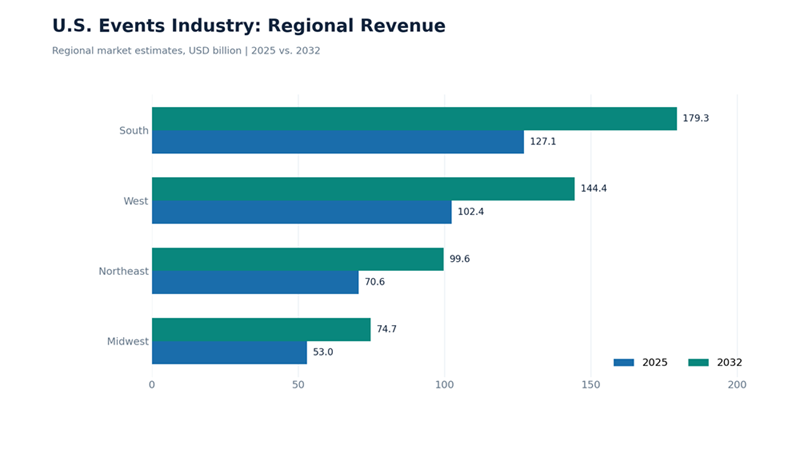
The Southern United States Events Industry Market was valued at approximately USD 127.12 billion in 2025, representing 36% of national revenue, and is projected to reach USD 179.32 billion by 2032. Annual activity is estimated at approximately 3.50 million events, increasing to 4.25 million by 2032. Texas, Florida, Georgia, North Carolina, and Tennessee provide a substantial commercial base through corporate gatherings, exhibitions, professional sports, weddings, and entertainment.
Texas and Florida are the region's largest state markets, generating approximately USD 33.14 billion and USD 27.03 billion respectively in 2025. Dallas–Fort Worth benefits from corporate meetings, professional sports, conventions, and private celebrations, while Orlando remains one of the country's leading destinations for large exhibitions and business conferences. The Orange County Convention Center hosted approximately 187 events attracting 2.05 million attendees in 2025, demonstrating the concentration of professional event activity in major convention facilities.
Atlanta contributes significant convention and stadium activity. The Georgia World Congress Center Authority reported approximately 3.46 million attendees across its major convention and stadium facilities during fiscal 2025. Nashville supports a different commercial mix, combining live entertainment, music-related experiences, corporate meetings, and destination celebrations. Across the South, major event venues generate high-value contracts, while the region's large population sustains recurring spending on weddings, community events, and smaller corporate gatherings.
The regional opportunity is particularly strong for exhibition-service providers, convention venues, hotel-based event operators, production companies, and professional planners. Competition is increasing among established destinations seeking national conferences and major sporting events, making venue capacity, service costs, accessibility, and recurring event bookings important commercial considerations.
Western United States - California Entertainment and Las Vegas Conventions Support Premium Event Spending
The Western United States Events Industry Market accounted for approximately USD 102.39 billion in 2025, equivalent to 29% of national revenue, with spending projected to reach USD 144.45 billion by 2032. Annual commercial event volume is estimated at 2.15 million, increasing to 2.60 million by 2032. California and Nevada represent particularly important markets, supported by entertainment, corporate gatherings, conventions, exhibitions, and premium private events.
California generated an estimated USD 55.67 billion in 2025, making it the largest individual state market. Los Angeles benefits from concerts, professional sports, entertainment launches, conventions, awards events, and private celebrations. San Francisco and the wider Bay Area contribute technology conferences, corporate gatherings, product launches, professional networking, and specialist business events. The region's entertainment and technology businesses create significant opportunities for premium audiovisual production, staging, event technology, and experiential agencies.
Las Vegas provides a concentrated market for large conventions and entertainment. According to the Las Vegas Convention and Visitors Authority, the city welcomed approximately 5.99 million convention delegates in 2025, supported by more than 14.5 million square feet of meeting space. Convention participation remained relatively stable despite a 7.5% decline in total destination visitation. The city's exhibition and corporate-event infrastructure provides substantial recurring opportunities for stand contractors, audiovisual suppliers, event organizers, caterers, and venue operators.
Western event businesses benefit from established entertainment destinations and premium corporate clients, although labor costs, venue pricing, and complex production requirements can increase operating expenses. Major convention centers, concert venues, and specialist production facilities remain central to regional competition.
Northeastern United States - New York Corporate Events and Premium Entertainment Generate High-Value Business
The Northeastern United States Events Industry Market generated approximately USD 70.64 billion in 2025, accounting for 20% of national revenue, and is projected to reach USD 99.62 billion by 2032. Annual event volume is estimated at 1.65 million, increasing to 1.95 million by the end of the forecast period. New York, Pennsylvania, New Jersey, and Massachusetts represent the principal commercial markets.
New York generated approximately USD 29.51 billion in state-level event spending in 2025, supported by corporate conferences, financial-services meetings, professional sports, concerts, theater, exhibitions, and premium celebrations. New York City is particularly important for high-value corporate experiences and entertainment, with spending concentrated among major venues, convention operators, agencies, and specialist suppliers.
Pennsylvania contributed approximately USD 13.86 billion, while New Jersey generated USD 10.06 billion. Philadelphia, Boston, and surrounding metropolitan markets provide additional activity through healthcare conferences, university events, association meetings, concerts, professional sports, and private celebrations. The region's extensive professional-services economy supports recurring corporate and institutional gatherings.
The Northeast's commercial strength lies in established corporate relationships and premium event spending. However, venue costs, staffing expenses, and supplier pricing can influence profitability. Event agencies and venue operators compete on service quality, location, production capability, and their ability to secure repeat corporate and institutional contracts.
Midwestern United States - Industrial Trade Shows and Regional Events Sustain Commercial Activity
The Midwestern United States Events Industry Market was valued at approximately USD 52.98 billion in 2025, representing 15% of national revenue, and is projected to reach USD 74.72 billion by 2032. Annual activity is estimated at approximately 1.60 million events, rising to 1.95 million by 2032. Illinois, Ohio, Michigan, Minnesota, and Missouri account for much of the region's commercial event activity.
Illinois represents the region's largest state market at approximately USD 10.68 billion in 2025, supported by Chicago's convention infrastructure and professional events business. McCormick Place provides approximately 2.6 million square feet of exhibition space and hosts major industrial and professional gatherings. FABTECH 2025 attracted approximately 50,000 attendees and more than 1,700 exhibitors, demonstrating the importance of manufacturing exhibitions for event organizers, contractors, and technical-service providers.
Ohio, Michigan, and Minnesota support additional activity through industrial conferences, trade exhibitions, collegiate and professional sports, concerts, weddings, and state fairs. The Midwest's combination of national exhibitions and local events provides revenue opportunities for convention facilities, stand contractors, staging companies, audiovisual suppliers, and independent planners.
Which Cities Represent the Largest Commercial Opportunities?
New York City - Corporate Headquarters and Premium Entertainment Sustain High Event Spending
New York City generated an estimated USD 23 billion in 2025, with revenue projected to reach approximately USD 32.4 billion by 2032. Annual commercial activity is estimated at 420,000 events, covering corporate meetings, financial conferences, product launches, professional sports, Broadway productions, concerts, and private celebrations.
Corporate clients and established entertainment venues create high-value contracts for production specialists, event agencies, venue operators, and hospitality providers. The city's concentration of financial institutions, professional-services businesses, cultural venues, and international organizations supports recurring events throughout the year. High venue and staffing costs create pressure on smaller organizers, while established suppliers benefit from repeat relationships with enterprise and institutional clients.
Los Angeles - Entertainment, Sports, and Corporate Experiences Drive a Diverse Market
Los Angeles generated an estimated USD 21 billion in 2025, projected to reach USD 29.6 billion by 2032, with approximately 440,000 commercially organized events. Entertainment launches, concerts, major sporting competitions, conferences, corporate experiences, and private celebrations account for the principal commercial activities.
Los Angeles welcomed approximately 49.5 million visitors in 2025, while the Los Angeles Convention Center hosted 19 citywide conventions attracting more than 260,000 attendees. The city's event economy provides opportunities for staging companies, audiovisual specialists, promoters, security contractors, venue operators, and premium hospitality businesses. Major sporting events scheduled later in the decade are also expected to increase temporary infrastructure and production spending.
Las Vegas - Large Conventions Generate Recurring Exhibition and Production Contracts
Las Vegas generated approximately USD 10 billion in event-related spending in 2025, projected to reach USD 14.1 billion by 2032. Its annual commercial event volume is estimated at 140,000 gatherings. The city recorded approximately 5.99 million convention delegates during 2025, supported by extensive exhibition facilities, hotels, arenas, and entertainment venues.
Trade shows and conventions generate revenue through exhibition space, sponsorship, registration, stand construction, audiovisual production, and related services. Concert residencies, sporting events, and premium hospitality add substantial commercial activity. Las Vegas benefits from large event facilities and established organizer relationships, although its performance remains sensitive to business travel budgets and the operating costs of major productions.
Orlando - Large Association Conferences and Exhibitions Strengthen Venue Activity
Orlando generated approximately USD 9 billion in 2025, increasing to a projected USD 12.7 billion by 2032. Annual commercially organized events are estimated at 170,000. The Orange County Convention Center's approximately 2.05 million attendees in 2025 demonstrate the scale of its professional meetings and exhibition activity.
Medical associations, professional organizations, consumer exhibitions, and corporate conferences contribute significant venue, registration, catering, and production spending. Large hotels and convention facilities support recurring contracts for audiovisual suppliers, exhibition contractors, and event-management companies. Continued investment in meeting facilities can strengthen Orlando's ability to attract national conferences and major professional events.
Chicago - Industrial Exhibitions and Professional Conferences Anchor Commercial Demand
Chicago accounted for approximately USD 8 billion in event spending in 2025, projected to reach USD 11.3 billion by 2032, with around 230,000 commercially organized events. McCormick Place, major hotels, convention facilities, sports venues, and entertainment infrastructure support national exhibitions and recurring professional gatherings.
Manufacturing, healthcare, technology, and industrial trade shows are particularly important for exhibition organizers and specialist contractors. Large events generate concentrated spending on venue services, booth construction, registration, logistics, production, and sponsorship. Chicago's established exhibition portfolio provides recurring opportunities for suppliers serving national and international industry gatherings.
Dallas - Fort Worth and Atlanta: Corporate Activity and Major Sports Venues Broaden Revenue Opportunities
Dallas–Fort Worth generated an estimated USD 10 billion in 2025, with revenue projected to reach USD 14.1 billion by 2032. Approximately 300,000 commercial events are estimated annually, supported by corporate meetings, conferences, sports, exhibitions, weddings, and private celebrations. Dallas remained among the leading North American meeting destinations in Cvent's 2026 rankings, reflecting its established position in corporate venue sourcing.
Atlanta contributed approximately USD 6 billion in 2025, increasing to USD 8.5 billion by 2032, with around 170,000 annual events. The city's convention infrastructure and major sports facilities generate spending on exhibitions, conferences, concerts, sporting competitions, and technical production. Corporate headquarters, professional associations, and regional businesses add recurring meetings and event-management opportunities.
Nashville and Washington, D.C. - Entertainment and Institutional Events Support Specialized Markets
Nashville generated an estimated USD 4 billion in 2025, projected to reach USD 5.6 billion by 2032. Music events, concerts, conferences, weddings, and destination celebrations account for substantial activity. The city ranked third among North American meeting destinations in Cvent's 2026 rankings, reflecting growing competition for corporate conferences and professional events.
Washington, D.C., generated an estimated USD 5 billion in 2025, projected to reach USD 7.1 billion by 2032. Government conferences, professional associations, academic gatherings, nonprofit events, and institutional meetings provide recurring business for venues and service companies. Event spending is closely connected to conference approvals, association budgets, government procurement, and professional meeting activity.
How Are Leading Companies Competing Across the United States Events Industry Market?
The United States Events Industry Market includes major international organizers, national event-production specialists, venue operators, technology providers, and thousands of independent planning companies. Large businesses control important positions in concerts, exhibitions, and complex event production, while weddings, private celebrations, regional conferences, and community gatherings remain highly fragmented.
Live Nation Entertainment is one of the industry's largest commercial participants, reporting USD 25.2 billion in global revenue in 2025, an increase of 9% from the previous year. Its Concerts business generated approximately USD 20.9 billion, while sponsorship adjusted operating income reached USD 845 million. The company hosted approximately 159 million concertgoers globally across 55,000 shows. Its competitive position combines concert promotion, ticketing, venue relationships, and sponsorship, allowing it to participate in several sources of event spending. These figures represent worldwide operations rather than U.S.-only revenue.
Informa reported approximately GBP 4.04 billion in group revenue in 2025, including GBP 3.00 billion from its B2B Live Events businesses. Informa Markets recorded 10.8% underlying growth, supported by specialized exhibitions and established industry event brands. Its commercial position reflects the importance of recurring exhibitors, professional audiences, and industry-specific events. RELX, through RX, reported approximately GBP 1.19 billion in Exhibitions revenue during 2025, with underlying growth of approximately 8%. The performance of these businesses demonstrates the commercial value of recurring exhibition franchises and long-term relationships with exhibitors and industry participants.
Freeman competes in exhibition services, show-floor construction, event production, and logistics, while Encore maintains substantial exposure to hotel-based conferences, meetings, and audiovisual production. Production Resource Group (PRG) serves large concerts, corporate launches, sporting events, and complex entertainment productions through specialist lighting, video, audio, staging, and engineering services. These companies operate in areas where production complexity, equipment availability, workforce capability, and event scheduling influence contract value and profitability.
George P. Johnson and Jack Morton compete in corporate experiences, brand launches, experiential marketing, and professional gatherings. Cvent provides event-management technology, registration, venue sourcing, and attendee engagement services, supporting recurring corporate and institutional event programs. AEG Presents competes in concert promotion, touring, festivals, and entertainment venue activity.
The social-event industry has a different competitive structure. Premium wedding and private-event specialists operate alongside thousands of regional planners, caterers, decorators, photographers, and venue businesses. Most compete through local supplier relationships, service quality, reputation, and repeat referrals rather than national market share. This fragmentation allows regional businesses to maintain meaningful commercial positions even as large organizers expand their event portfolios.
Which Developments Will Influence Industry Revenue Through 2032?
Corporate conferences and exhibitions will remain important sources of professional event spending. The combined Corporate & Business Events and Trade Shows & Exhibitions categories generated an estimated USD 116 billion in 2025. Recurring industry conferences, association events, and corporate gatherings create opportunities for venue operators, audiovisual suppliers, exhibition contractors, and event-management companies. Major destinations continue investing in convention facilities and event infrastructure to attract national gatherings and secure longer-term bookings.
Live entertainment and sports will create additional opportunities through premium services and sponsorship. Together, these categories represented approximately USD 115.97 billion in 2025. Established concerts and professional sporting events can generate substantial expenditure through general admission, premium seating, hospitality, concessions, venue services, and production contracts. Major promoters and venue operators are increasingly focused on audience spending beyond the initial ticket purchase, while production costs and ticket affordability remain important commercial considerations.
Weddings and private celebrations will continue supporting local event businesses. The Social & Personal Events category contributed approximately USD 86.16 billion in 2025. Wedding expenditure provides a recurring customer base for venues, caterers, decorators, photographers, entertainment providers, and planners. Premium hospitality packages and professionally organized celebrations provide opportunities for higher spending per event, although household budgets and service costs can affect purchasing decisions.
Convention and entertainment infrastructure will influence regional competition. Las Vegas, Orlando, Chicago, Los Angeles, and Atlanta continue to compete for large conferences, exhibitions, concerts, and sporting events. Investment in convention space, audiovisual facilities, stadiums, and event venues can improve capacity and attract more complex productions. For suppliers, recurring event calendars and strong venue relationships are particularly valuable because equipment utilization, staffing efficiency, and contract continuity influence profitability.
Analyst Commentary
"The United States Events Industry Market offers considerable opportunities beyond ticketing and event attendance. Corporate conferences and exhibitions provide recurring contracts, while concerts and professional sports generate higher spending on sponsorships, premium hospitality, and production. Competition is particularly strong in major convention and entertainment destinations, where venue availability and operating costs influence profitability. For event companies, long-term contracts, strong venue partnerships, and consistent bookings remain more valuable than simply increasing the number of events organized."