

Revenue-Based Financing Market (2026-2032)
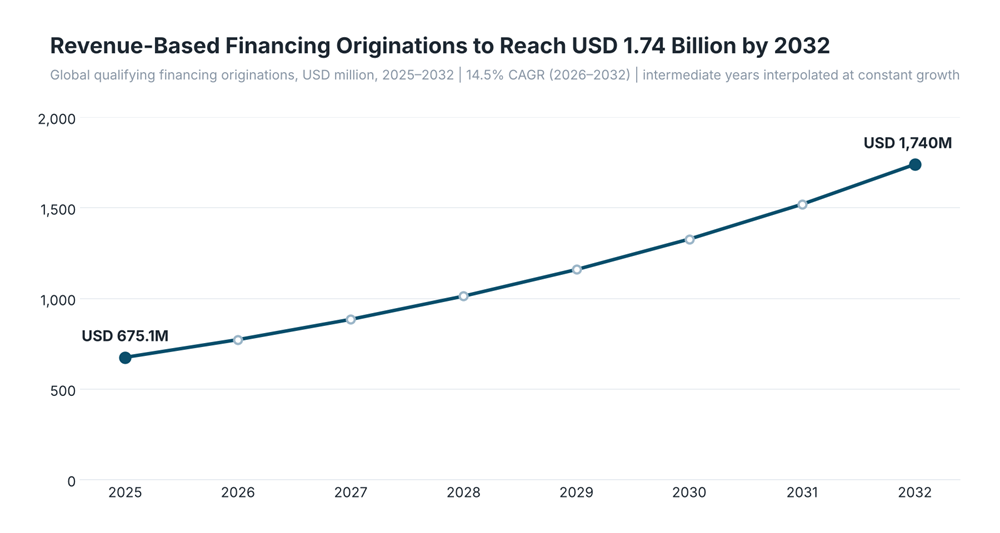
The Global Revenue-Based Financing Market was estimated at USD 675.1 million in 2025 and is projected to reach USD 1.74 billion by 2032, growing at a CAGR of 14.5% during 2026-2032.



Quick Enquiry
How Are Non-Dilutive Financing and SME Growth Capital Shaping the Global Revenue-Based Financing Market?
The Global Revenue-Based Financing Market was estimated at USD 675.1 million in 2025 and is projected to reach USD 1.74 billion by 2032, growing at a CAGR of 14.5% during 2026–2032, according to preliminary estimates by MarketsandStats. Software companies, e-commerce businesses and established SMEs are major recipients of revenue-linked financing, with the United States representing the largest country market, followed by growing financing activity in the United Kingdom and India. Market estimates reflect annual qualifying financing originations rather than financing-provider earnings.
Growing adoption of non-dilutive funding is expanding opportunities for specialist financing providers. Lighter Capital reports more than USD 550 million in cumulative financing provided to over 660 startups, primarily serving technology and SaaS businesses. In April 2025, Wayflyer reported over USD 5 billion in cumulative working capital deployed to more than 5,000 businesses across 11 countries, including USD 2.8 billion in the United States. Its financing portfolio spans merchant advances and fixed-payment products. Increasing capital requirements for inventory, customer acquisition and business expansion are encouraging revenue-generating companies to explore alternative funding options while retaining equity ownership.
Institutional Investment Strengthens Financing Capacity for Technology Businesses
Institutional funding is expanding the lending capacity of specialist revenue-based financing providers. In January 2025, Lighter Capital announced a USD 30 million funding facility in Australia, backed by the Victorian Government and iPartners, to finance SaaS, subscription and digital media businesses. In November 2025, the company secured up to USD 100 million in credit financing from i80 Group, increasing its capacity to provide non-dilutive capital to established technology companies. Source: Lighter Capital
Decathlon Capital Partners offers growth financing ranging from USD 500,000 to USD 15 million, targeting businesses with approximately USD 4 million to USD 100 million in annual revenue. Its portfolio spans technology, healthcare, industrial services and other established enterprises. Larger institutional funding facilities and specialist financing arrangements are increasing capital availability for revenue-generating SMEs seeking expansion financing without equity dilution. Source: Decathlon Capital Partners
Capped Revenue-Based Financing Dominates Global Originations Through Predictable Repayment Limits
Capped Revenue-Based Financing accounted for an estimated 92% of global originations, valued at USD 621.1 million in 2025, and is projected to reach USD 1.60 billion by 2032, growing at a CAGR of 14.5%. Uncapped financing represented the remaining 8%, valued at USD 54.0 million, and is expected to reach USD 139.4 million by 2032.
Capped financing maintains its leading position because businesses can establish maximum repayment obligations upfront while adjusting monthly payments to revenue performance. Lighter Capital typically offers repayment caps of 1.3–1.5 times the financing amount, providing businesses with predictable financing costs while helping providers assess investment returns.
A 2025 academic study by Clarke, Russel and Shi examined 15,375 initial advances and 23,879 repeat advances at a South African fintech platform, reporting average repayment factors of 1.28 and 1.37 times principal, respectively. Although the study covered merchant advances, its findings offer a useful pricing reference for the broader revenue-linked financing industry.
Working Capital Financing Leads as SMEs Prioritize Operational Liquidity
Working Capital Financing accounted for approximately 23% of the Revenue-Based Financing Market, valued at USD 155.3 million in 2025, and is projected to reach USD 400.6 million by 2032, growing at a CAGR of 14.5%. Business Expansion followed with a 19% share, valued at USD 128.3 million, while Inventory & Procurement Financing and Marketing & Customer Acquisition represented USD 121.5 million and USD 114.8 million, respectively.
Working capital holds the largest share as day-to-day funding requirements arise more frequently than major expansion projects. E-commerce brands and SMEs regularly finance supplier payments, inventory cycles, and operating expenses, creating recurring opportunities for financing providers. In July 2025, Clearco introduced Rolling Funding, allowing eligible e-commerce businesses to replenish available capital as existing advances are repaid.
Business expansion financing is gaining traction among established companies investing in sales operations and market penetration. In June 2025, Decathlon Capital Partners announced multimillion-dollar financing for Strategikon Pharma, supporting additional sales and customer-service capacity. Its financing arrangements with Flamebar Investments and PreFix further demonstrate the use of revenue-linked capital for expansion across software, industrial, and technology-enabled service businesses. Source: Decathlon Capital Partners
Small Enterprises Account for the Largest Share of Revenue-Based Financing Originations
Small Enterprises accounted for approximately 44% of the Revenue-Based Financing Market, valued at USD 297.0 million in 2025, and are projected to reach USD 766.4 million by 2032, expanding at a CAGR of 14.5%. Medium Enterprises followed with a 42% share, equivalent to USD 283.5 million in 2025, and are expected to reach USD 731.6 million by 2032. Together, SMEs represented approximately 86% of global qualifying originations.
The strong presence of small enterprises reflects the growing reach of fintech lending platforms among businesses with established sales but limited access to conventional bank financing. Smaller transaction sizes and digital underwriting allow specialist providers to serve a broader range of businesses, particularly those with limited physical collateral or shorter credit histories. Novel Capital offers initial funding generally between USD 100,000 and USD 1 million to eligible software companies, while Decathlon Capital Partners extends larger financing arrangements to established businesses. The different funding ranges highlight how specialist financing providers address distinct enterprise sizes and capital requirements.
E-Commerce and D2C Retail Lead Revenue-Based Financing Through High Financing Activity Among Consumer Brands
E-commerce & D2C Retail accounted for the largest estimated end-user share at 37%, valued at USD 249.8 million in 2025, and is projected to reach USD 644.5 million by 2032, expanding at a CAGR of 14.5%. Software & SaaS followed with a 35% share, equivalent to USD 236.3 million in 2025, while Consumer Services represented 9%, valued at USD 60.8 million.
E-commerce leads as established consumer brands increasingly rely on external capital to fund inventory turnover, advertising campaigns, and expansion across online and physical retail channels. The scale of financing activity is reflected in Clearco's September 2025 announcement of more than USD 3 billion deployed to over 10,000 businesses, alongside Wayflyer's USD 5 billion in cumulative financing across 11 countries by April 2025. Both providers have expanded beyond traditional revenue-based financing into broader merchant funding products, demonstrating the substantial financing activity associated with e-commerce businesses.
Software & SaaS remains another major end-user industry, supported by recurring subscription income and financing requirements for sales teams, product commercialization, and customer acquisition. Specialist financing providers serve technology businesses at different stages of expansion, reinforcing SaaS companies' significant participation in the revenue-based financing industry.
Sources: Clearco | Wayflyer
SaaS Financing Attracts Institutional Capital as Specialist Providers Expand Funding Capacity
SaaS companies represent a significant market for revenue-based financing, supported by subscription-based income and sustained investment in sales expansion and software commercialization. Institutional funding is strengthening specialist lenders' ability to finance established technology businesses. In 2025, Lighter Capital secured a USD 30 million Australian financing facility and a credit facility of up to USD 100 million from i80 Group, expanding its capacity to serve software and subscription businesses across North America and Australia.
Novel Capital focuses on established B2B software companies, while Decathlon Capital Partners provides larger structured financing arrangements. In June 2025, Decathlon financed Strategikon Pharma's clinical-trial software expansion, highlighting the role of revenue-linked capital in supporting established SaaS businesses. The participation of institutional lenders and specialist financing providers reflects increasing capital availability across different stages of software business development.
United States Leads Revenue-Based Financing Through an Established Specialist Lending Ecosystem
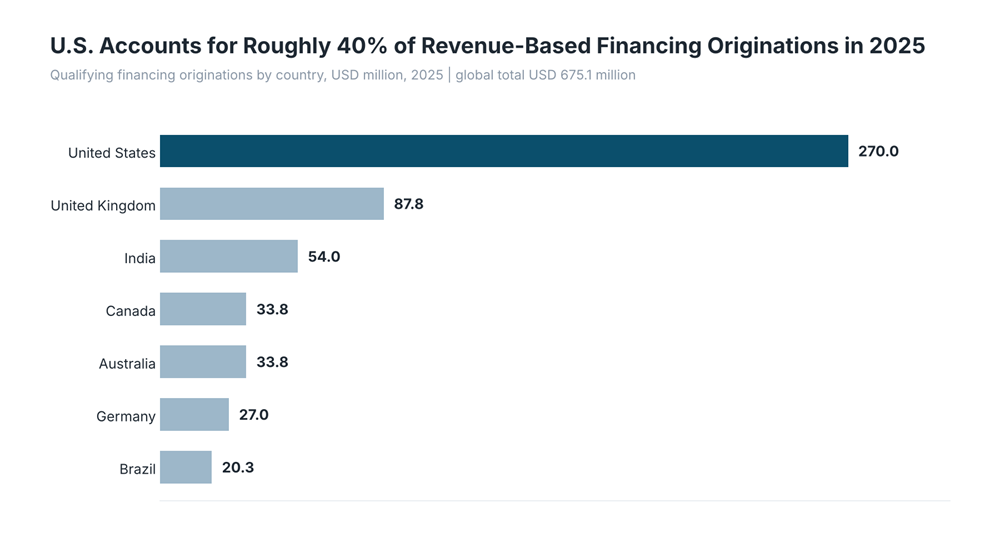
The United States Revenue-Based Financing Market was estimated at USD 270.0 million in 2025, accounting for approximately 40% of global qualifying originations, and is projected to reach USD 696.7 million by 2032, expanding at a CAGR of 14.5%.
The country's leading position reflects its established network of specialist financing providers and extensive base of revenue-generating technology companies, SaaS businesses, and consumer brands. Lighter Capital, Decathlon Capital Partners, and Novel Capital serve different financing requirements across these industries, while embedded lending platforms extend funding access to online merchants.
By April 2025, Wayflyer had deployed more than USD 2.8 billion to over 2,000 US businesses and subsequently expanded its American presence with a hub in Charlotte, North Carolina. The scale of merchant financing activity, alongside established specialist lenders, reinforces the United States' leadership in the broader revenue-linked business financing ecosystem.
United Kingdom: Embedded Financing Partnerships Strengthen SME Funding Access
The United Kingdom Revenue-Based Financing Market was estimated at USD 87.8 million in 2025, representing approximately 13% of global originations, and is projected to reach USD 226.4 million by 2032, expanding at a CAGR of 14.5%.
The UK's position is supported by its established fintech lending industry and growing use of embedded financing through business platforms. Liberis distributes funding through commercial partnerships, enabling SMEs to access capital within existing business services, while Outfund provides non-dilutive financing to established digital businesses. The presence of specialist lenders and platform-based financing channels strengthens funding accessibility for online merchants and SMEs, with revenue-participation agreements forming part of the wider alternative-financing landscape.
India: Digital Commerce Financing Expands Opportunities for Revenue-Linked Capital
The India Revenue-Based Financing Market was estimated at USD 54.0 million in 2025, accounting for approximately 8% of global originations, and is projected to reach USD 139.4 million by 2032, growing at a CAGR of 14.5%.
India's revenue-linked financing activity is closely associated with the expansion of D2C brands, online retail businesses, and digitally operating SMEs. GetVantage and Klub provide financing solutions for revenue-generating businesses, particularly those investing in inventory, advertising, and distribution expansion. Velocity also serves digital commerce businesses through fixed-repayment financing products. The presence of multiple specialist platforms reflects the widening range of financing options available to established Indian consumer brands, although traditional revenue-share agreements represent only part of the broader fintech funding ecosystem.
Canada: Established Fintech Providers Serve E-Commerce and Growth-Stage Businesses
The Canada Revenue-Based Financing Market was estimated at USD 33.8 million in 2025, representing approximately 5% of global qualifying originations, and is projected to reach USD 87.1 million by 2032, expanding at a CAGR of 14.5%.
Canada's market presence is supported by established alternative-financing firms serving digital retailers and growth-stage technology companies. Clearco has built an international e-commerce financing business, while Flow Capital's experience in royalty-based investments and subsequent shift toward venture debt reflects the evolving financing options available to Canadian businesses. Both companies illustrate the broader non-dilutive financing landscape, with traditional revenue-participation agreements representing a narrower product category.
Australia: Institutional Funding Expands Technology Financing Capacity
The Australia Revenue-Based Financing Market was estimated at USD 33.8 million in 2025 and is projected to reach USD 87.1 million by 2032, growing at a CAGR of 14.5%.
Australia is attracting specialist financing capital for established SaaS and subscription-based technology businesses. In January 2025, Lighter Capital announced a USD 30 million Australian funding facility involving the Victorian Government and iPartners, strengthening financing capacity for revenue-generating technology companies. The participation of institutional and public-sector capital reflects increasing interest in non-dilutive financing opportunities within Australia's technology ecosystem. Source: Lighter Capital
Germany: SME Financing Providers Expand Alternative Credit Options
The Germany Revenue-Based Financing Market was estimated at USD 27.0 million in 2025, representing approximately 4% of global originations, and is projected to reach USD 69.7 million by 2032, expanding at a CAGR of 14.5%.
Germany's established SME and technology business base provides opportunities for specialist financing arrangements outside traditional bank lending. Berlin-based re operates in the wider alternative corporate-financing industry, offering interest-bearing credit facilities rather than conventional revenue-participation agreements. Its presence reflects the wider range of funding structures available to German businesses, while revenue-based financing remains a more specialized category.
Brazil: Digital Businesses Create Opportunities for Revenue-Linked Financing
The Brazil Revenue-Based Financing Market was estimated at USD 20.3 million in 2025 and is projected to reach USD 52.3 million by 2032, expanding at a CAGR of 14.5%.
Brazil's revenue-linked financing opportunities are associated with online merchants, digital service providers, and SMEs seeking alternatives to conventional bank credit. Businesses with transaction-based sales histories offer a potential customer base for financing providers using revenue performance in credit assessments. The market remains at an earlier stage of specialist RBF development, with future opportunities linked to the expansion of digital commerce financing and greater availability of structured non-bank capital.
Competitive Landscape: Specialist Financing Providers Compete Through Capital Availability and Industry Focus
The Revenue-Based Financing Market remains fragmented, with specialist lenders competing through financing capacity, transaction size, and industry specialization. Lighter Capital has reported more than USD 550 million in cumulative financing activity and strengthened its institutional funding capacity in 2025 through agreements involving i80 Group and Australian investment partners. Decathlon Capital Partners offers financing ranging from USD 500,000 to USD 15 million, targeting established technology, healthcare software, and industrial businesses.
Larger alternative-financing platforms have established substantial funding operations. Wayflyer reported over USD 5 billion in cumulative financing by April 2025, while Clearco surpassed USD 3 billion in financing across more than 10,000 businesses by September 2025. Both operate broader financing portfolios that extend beyond traditional revenue-based financing. Novel Capital, GetVantage, Klub, and Outfund further diversify competition across SaaS businesses, consumer brands, and SMEs.
Institutional capital access and financing specialization increasingly influence competitive positioning, allowing established providers to support larger transactions and reach additional business categories. However, company-specific shares of traditional RBF originations remain difficult to establish, as reported financing volumes frequently combine revenue-based agreements with other non-dilutive funding products.
Recent Developments: Institutional Investment and Financing Innovations Reshape Market Competition
Revenue-based financing providers expanded their capital resources and financing portfolios throughout 2025, strengthening competition across technology businesses and SMEs.
- November 2025 – Lighter Capital: Secured a credit facility of up to USD 100 million from i80 Group, following a USD 30 million Australian funding facility announced in January, expanding its financing capacity for technology companies.
- June 2025 – Decathlon Capital Partners: Announced multimillion-dollar financing for Strategikon Pharma to support commercial expansion, alongside 2025 investments involving Flamebar Investments and PreFix.
- July–September 2025 – Clearco: Introduced Rolling Funding and expanded its financing offerings for inventory purchases, supplier payments, and business expansion among e-commerce brands.
- October 2025 – Wayflyer: Launched Hosted Capital, enabling commercial platforms to integrate business financing into their services and expanding its distribution opportunities.
Institutional funding commitments and platform-integrated financing are emerging as important competitive differentiators, strengthening capital availability and extending financing access across established digital businesses.
Analyst Commentary
“The biggest challenge for revenue-based financing providers is maintaining profitability as competition for established, revenue-generating businesses increases. Financing companies with lower capital costs, disciplined credit assessment, and strong repayment performance are better positioned to expand their portfolios. SaaS businesses offer attractive recurring-revenue profiles, while e-commerce financing carries greater exposure to seasonal sales and customer acquisition costs. Providers that prioritize portfolio quality over financing volume are likely to achieve stronger long-term returns.”
Key Sources
- Wayflyer - USD 5 Billion Cumulative Financing Deployment
- Wayflyer - Company Financing Announcements
- Lighter Capital - Financing Facilities and Company Developments
- Decathlon Capital Partners - Growth Financing Terms
- Decathlon Capital Partners - Revenue-Based Financing Transactions
- Clearco - Rolling Funding Launch
- Clearco - Company Financing Developments
- Lighter Capital - Revenue-Based Financing Terms
- Clarke, Russel and Shi - Revenue-Based Financing Research