

Prepaid Card Market (2026-2032)
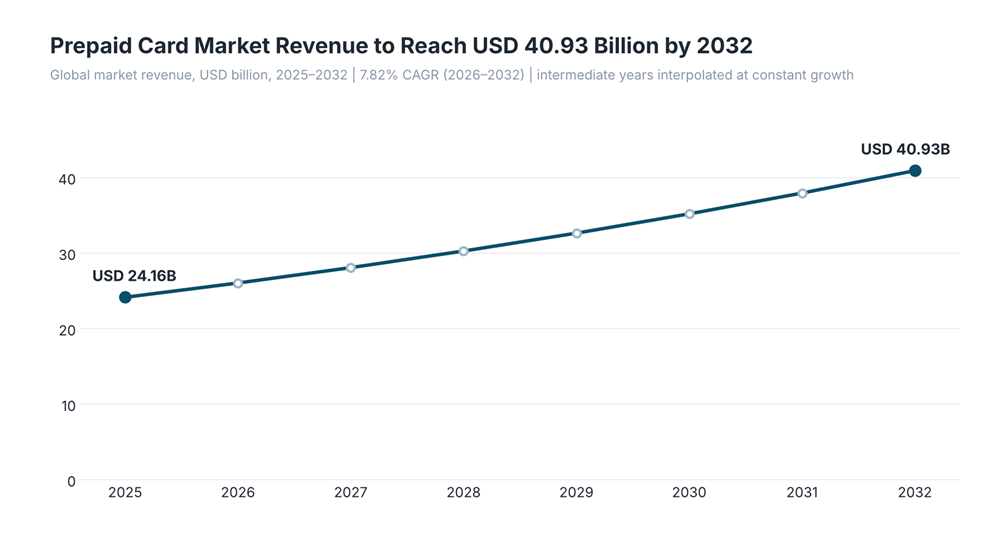
The Global Prepaid Card Market was estimated at USD 24.16 billion in 2025 and is projected to reach USD 40.93 billion by 2032, expanding at a CAGR of 7.82% during 2026-2032.


Quick Enquiry
How Are Prepaid Cards Reshaping Consumer Spending and Commercial Payments?
The Global Prepaid Card Market was estimated at USD 24.16 billion in 2025 and is projected to reach USD 40.93 billion by 2032, expanding at a CAGR of 7.82% during 2026-2032, according to MarketsandStats. Market revenue is generated through card issuance, transaction processing, interchange fees, program management, and related payment services. General-purpose reloadable cards, retail gift cards, payroll cards, government benefit cards, and corporate prepaid programs represent major commercial categories.
Prepaid card transactions generate substantial recurring revenue for issuers and payment processors. According to the Federal Reserve's 2023 Interchange Fee Report, prepaid cards processed 9.24 billion purchase transactions valued at USD 340.49 billion in the United States, generating USD 5.24 billion in interchange revenue. Average interchange reached USD 0.57 per transaction, equivalent to approximately 1.54% of purchase value, highlighting the financial significance of prepaid transaction activity.
Corporate prepaid programs, payroll disbursements, and government benefit cards represent important sources of recurring payment activity, while retail gift cards remain closely associated with seasonal consumer spending. Card issuers and program managers compete across transaction fees, account servicing, enterprise contracts, and retail distribution, with commercial prepaid programs offering opportunities for longer-term customer relationships and repeat transactions.
Why Does the United States Remain Central to Prepaid Card Monetization?
The United States Prepaid Card Market was valued at an estimated USD 8.55 billion in 2025, accounting for approximately 35.4% of global revenue. Interchange fees contributed an estimated USD 5.94 billion, followed by USD 1.31 billion from cardholder and program fees, USD 900 million from closed-loop gift-card services, and USD 400 million from payment processing. Retail gift cards, payroll disbursements, government benefit programs, and corporate prepaid cards represent important revenue categories.
Gift cards remain a major commercial segment in the United States. The National Retail Federation projected USD 29.1 billion in gift-card purchases during the 2025 winter holiday season, compared with USD 28.6 billion in 2024. Meanwhile, InComm Payments' 2025 Gift Card Review found that spontaneous gift-card purchases increased 14% year on year, with nearly 30% growth among closed-loop gift-card shoppers. Strong retail demand and unplanned purchasing remain commercially important for gift-card issuers, distributors, and processing companies.
How Do Reloadable, Gift, Payroll, and Corporate Prepaid Cards Differ Commercially?
General-Purpose Reloadable Cards - Recurring Payment Activity Supports Fee Revenue
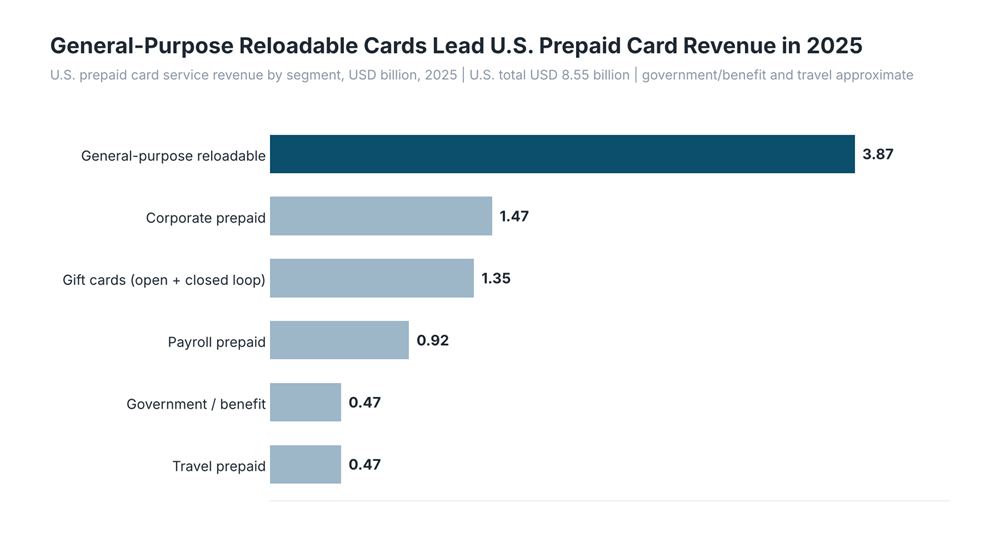
General-purpose reloadable prepaid cards remain an important segment for consumer payments, cash withdrawals, and controlled spending, with recurring transaction activity generating interchange, account servicing, and program management revenue. The segment generated an estimated USD 3.87 billion in service revenue in the United States in 2025, supported by recurring consumer purchases, account servicing, and payment processing.
According to Green Dot Corporation's 2025 Form 10-K, the company reported USD 2.08 billion in consolidated operating revenue in 2025, compared with USD 1.72 billion in 2024. Its prepaid card and broader financial services operations highlight the commercial importance of card fees, interchange, and payment processing. Competition from debit accounts, mobile wallets, and real-time payments continues to pressure traditional reloadable prepaid programs, making active card usage and recurring fee income important measures of financial performance.
Gift Cards - Retail Distribution and Digital Delivery Expand Commercial Opportunities
Gift cards remain an important revenue segment for retailers, issuers, and prepaid payment service providers, particularly through physical and digital distribution, corporate gifting, and merchant loyalty programs. According to Blackhawk Network's October 2025 holiday research, gift cards were expected to account for 39% of surveyed consumers' holiday gift budgets, highlighting their importance in seasonal retail spending.
Open-loop and closed-loop gift cards offer different revenue opportunities. In the United States, gift-card services generated an estimated USD 1.35 billion in 2025, including approximately USD 450 million from open-loop gift cards and USD 900 million from closed-loop gift-card services. Open-loop cards generate interchange and program-related fees, while closed-loop gift cards provide distribution commissions, activation fees, and merchant processing revenue. Digital gift-card fulfillment and retail distribution partnerships remain important areas of competition for prepaid card providers.
Payroll and Government Prepaid Cards - Disbursement Programs Create Recurring Payment Relationships
Payroll and government prepaid cards remain important segments for salary disbursements, public benefits, and institutional payment programs. Banks and payment providers generate revenue through recurring disbursements, transaction processing, account servicing, and long-term program contracts. In the United States, payroll prepaid cards generated an estimated USD 920 million in service revenue in 2025, while government and benefit prepaid card programs contributed approximately USD 470 million.
Government payment programs and employer-sponsored payroll cards provide established revenue opportunities for prepaid card issuers and processors. However, restrictions on cardholder fees, competitive procurement, and regulatory compliance continue to influence contract profitability. Government benefit transfer programs also have distinct fee structures from conventional network-branded prepaid cards.
Corporate and Travel Prepaid Cards - Greater Emphasis on Controlled Business Spending
Corporate prepaid cards are gaining importance in employee expense management, business travel, and international payments. In 2025, ICICI Bank and Visa launched the Corporate Sapphiro Forex Card, supporting transactions in 15 currencies and digital card loading for business travelers.
Corporate expense programs and virtual prepaid cards represent important revenue opportunities for issuers and payment processors, particularly through recurring enterprise contracts, foreign-exchange fees, and transaction processing. Corporate prepaid programs generated an estimated USD 1.47 billion in U.S. service revenue in 2025, while travel prepaid cards contributed approximately USD 470 million. Banks and fintech providers compete on international payment acceptance, corporate spending controls, and integrated expense management services.
What Are the Main Regional Opportunities in the Prepaid Card Market?
North America - Established Interchange Revenue and Gift-Card Distribution
North America leads the Global Prepaid Card Market, supported by the United States' established prepaid payment infrastructure, extensive retail gift-card distribution, and corporate and government disbursement programs. The U.S. accounted for an estimated USD 8.55 billion in prepaid card service revenue in 2025, representing approximately 35.4% of the global market.
According to the Federal Reserve's 2023 Interchange Fee Report, U.S. prepaid card transactions generated USD 5.24 billion in interchange revenue, equivalent to 1.54% of purchase value. Corporate prepaid programs, payroll cards, and gift-card distribution remain important revenue opportunities for North American issuers and payment processors, with transaction fees and recurring institutional contracts supporting industry earnings. U.S. prepaid interchange revenue was estimated at USD 5.94 billion in 2025, supported by transaction activity across consumer, payroll, government, and commercial prepaid programs.
Asia-Pacific - Different Payment Structures Create Uneven Prepaid Opportunities
Asia-Pacific remains an important market for prepaid cards, with Japan, India, and China offering distinct opportunities across stored-value payments, corporate prepaid programs, travel cards, and retail gifting. According to Japan's Ministry of Economy, Trade and Industry, electronic-money transactions reached JPY 6.0 trillion in 2025, while code-based payments totaled JPY 16.6 trillion. Japan's overall cashless payment ratio reached 58.0%, representing JPY 162.7 trillion in transaction value. Competition from QR-based payments remains significant for prepaid and stored-value card providers.
India offers established prepaid card activity alongside its rapidly expanding UPI ecosystem. According to the Reserve Bank of India's Payment System Indicators, prepaid cards recorded approximately 154.77 million transactions worth INR 48.33 billion in February 2025, excluding prepaid-wallet transactions. Corporate expense cards, international travel cards, retail gifting, and institutional disbursements remain important commercial applications, with banks and payment providers competing through specialized prepaid programs.
China's prepaid card industry is concentrated in regulated stored-value and merchant-specific payment programs, including retail gifting and restricted-use commercial cards. Widespread mobile payments and established bank-card networks create strong competition, with opportunities for prepaid issuers concentrated in specialized consumer and enterprise applications.
Europe - Digital Issuing and Commercial Payment Programs
Europe's Prepaid Card Market is gaining commercial opportunities across corporate expense management, travel cards, digital issuing, and merchant payment programs. According to the European Central Bank, the region recorded 5.1 billion electronic-money transactions worth approximately EUR 300 billion in the second half of 2025. Cards storing electronic money accounted for around 1% of these transactions and 3% of their value, highlighting the relatively small contribution of card-stored balances within the wider e-money ecosystem.
Digital card issuing is attracting investment from payment infrastructure providers. In 2025, Checkout.com and Visa announced a partnership to introduce physical and virtual card-issuing capabilities for merchants across the United Kingdom and Europe. Corporate prepaid programs, digital expense cards, and travel payments remain important opportunities, while interchange regulations and regional payment preferences influence issuer pricing and profitability.
Latin America - Brazil’s Prepaid Card Transactions Rise Despite an 8.4% Decline in Active Cards
Brazil remains an important Latin American prepaid card market, supported by recurring payment activity and established card acceptance infrastructure. According to the Central Bank of Brazil's H2 2025 Payment Statistics, the country recorded 63.6 million active prepaid cards at the end of 2025, down 8.4% year on year, while prepaid transaction volumes increased 2.2% during the second half of the year.
Prepaid interchange fees remain subject to a 0.70% regulatory ceiling in Brazil, creating a more restricted revenue environment for issuers than in the United States. Higher transaction activity, despite fewer active cards, places greater importance on card usage, processing revenue, and institutional prepaid contracts, with fee regulation remaining a key consideration for provider profitability.
Which Companies Are Shaping Competition in Prepaid Card Services?
Visa and Mastercard are major payment networks supporting prepaid card issuance and acceptance worldwide, with established banking partnerships across consumer, payroll, government, and corporate prepaid programs. Green Dot Corporation reported USD 2.08 billion in consolidated operating revenue in 2025, reflecting its participation in prepaid cards, banking services, and payment technology. Pathward is another important U.S. issuer, providing regulated banking infrastructure for prepaid programs and commercial payment services.
Blackhawk Network and InComm Payments hold established positions in gift-card distribution and prepaid program management, supported by retail partnerships, digital gifting, and merchant services. Fiserv and FIS compete through card processing and financial technology infrastructure serving banks and prepaid program operators. Interchange income, contracted program fees, and gift-card distribution commissions remain important revenue sources, while processing costs, merchant relationships, and institutional contracts influence supplier profitability.
How Are Recent Product Launches and Partnerships Changing the Competitive Landscape?
February 2025 - InComm Payments and Mastercard Introduced Give Hope Gift Cards: InComm Payments launched Mastercard-branded prepaid gift cards supporting the American Red Cross. The initiative expanded cause-related gifting within network-branded prepaid products and retail distribution channels.
June 2025 - ICICI Bank and Visa Launched the Corporate Sapphiro Forex Card: ICICI Bank and Visa introduced a corporate prepaid travel card supporting 15 currencies and digital card loading. The launch strengthened their presence in business travel payments and foreign-exchange prepaid services.
August 2025 - Checkout.com and Visa Announced a Card-Issuing Partnership: Checkout.com and Visa partnered to introduce physical and virtual card-issuing capabilities for merchants in the UK and Europe. The agreement expanded embedded card infrastructure opportunities, although the issuing services are not limited to prepaid cards.
October 2025 - Blackhawk Network Reported Strong Holiday Gift-Card Preferences: Blackhawk Network reported that gift cards were expected to represent 39% of surveyed consumers' holiday gift budgets. The findings reinforced the importance of retail gift-card distribution, digital gifting, and merchant partnerships during the holiday shopping season.
Analyst Commentary
“The biggest financial concern in the prepaid card industry is the gap between payment volume and the revenue issuers actually retain. Brazil's 0.70% interchange ceiling illustrates the pressure on issuer margins, while the U.S. market offers stronger interchange income but faces competition from digital wallets and conventional debit accounts. Corporate prepaid and payroll programs are particularly attractive for their recurring transaction activity and long-term institutional contracts. For investors, active card usage, net fee revenue per transaction, customer concentration, and program servicing costs are more meaningful indicators of profitability than the number of prepaid cards issued.”