
Multilayer Ceramic Capacitor Market (2026-2032)
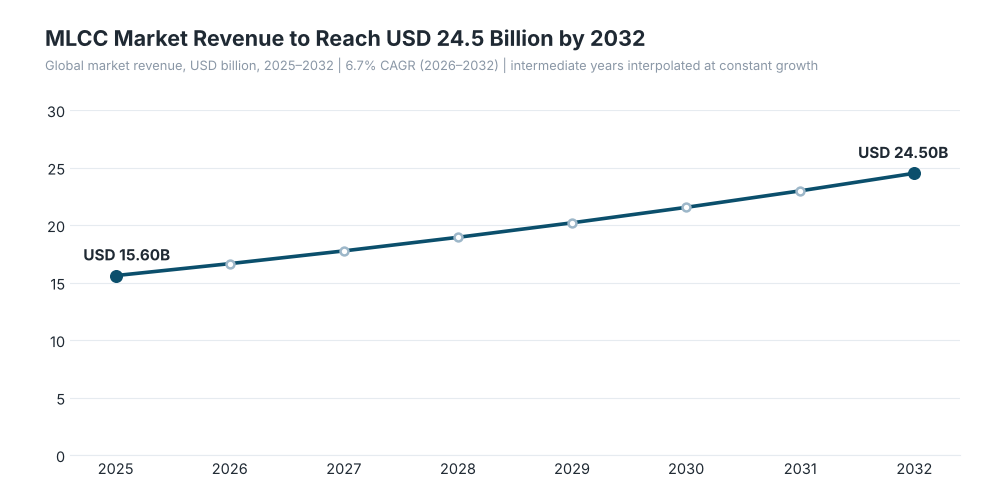
The Global Multilayer Ceramic Capacitor (MLCC) Market was valued at approximately USD 15.60 billion in 2025 and is projected to reach USD 24.50 billion by 2032, growing at a CAGR of 6.7% during 2026-2032.



Quick Enquiry
How Large Is the Global Multilayer Ceramic Capacitor Market?
The Global Multilayer Ceramic Capacitor (MLCC) Market was valued at approximately USD 15.60 billion in 2025 and is projected to reach USD 24.50 billion by 2032, growing at a CAGR of 6.7% during 2026-2032, according to MarketsandStats. Increasing demand for MLCCs in automotive electronics, servers, smartphones and industrial equipment is supporting market growth, particularly for compact, high-capacitance and automotive-grade capacitors.
Murata Manufacturing reported JPY 936.4 billion in capacitor revenue for the fiscal year ended March 2026, an increase of 12.6%, supported by stronger demand from server and smartphone manufacturers. Samsung Electro-Mechanics recorded approximately KRW 5.20 trillion in component business revenue in 2025, alongside a 0.9% increase in average MLCC selling prices, reflecting growing demand for higher-value capacitors.
According to Fusion Worldwide's June–July 2026 market updates, lead times for selected MLCC products reached approximately 26–40 weeks, particularly for high-capacitance, high-voltage and automotive-grade capacitors. Increasing demand for these specialized MLCCs is supporting higher-value orders and revenue opportunities for leading manufacturers.
AI Server Demand Drives High-Capacitance MLCC Sales
Growing demand for high-capacitance MLCCs in AI servers is creating significant revenue opportunities for leading manufacturers. In September 2026, Samsung Electro-Mechanics announced a KRW 1.0722 trillion (approximately USD 780 million) MLCC supply contract for AI servers in 2027, its largest disclosed MLCC agreement, alongside long-term contracts with more than ten global customers.
According to Samsung Electro-Mechanics, AI servers can require more than ten times as many MLCCs as conventional servers, reflecting higher capacitor demand in advanced computing systems. Increasing orders for compact, high-capacitance MLCCs are supporting premium product sales and long-term revenue opportunities for manufacturers serving the server market.
High-Capacitance and Automotive-Grade MLCCs Record Price Increases
Increasing demand for high-capacitance and automotive-grade MLCCs supported higher prices for selected capacitor products in 2026. According to TrendForce's August 2026 industry update, Samsung Electro-Mechanics increased MLCC quotations to OEM and ODM customers, while Taiwanese and Chinese manufacturers reported improved production utilization. Fusion Worldwide also identified price increases of approximately 15–35% for selected high-capacitance and automotive-grade MLCCs.
Meanwhile, TDK's fiscal 2026 results showed stronger ceramic capacitor sales in automotive and industrial applications, although lower average selling prices affected profitability. These developments highlight growing revenue opportunities in specialized MLCC categories, particularly for manufacturers serving advanced computing and automotive electronics.
Which Applications Offer the Strongest MLCC Revenue Opportunities?
AI Servers: Fastest-Growing MLCC Application
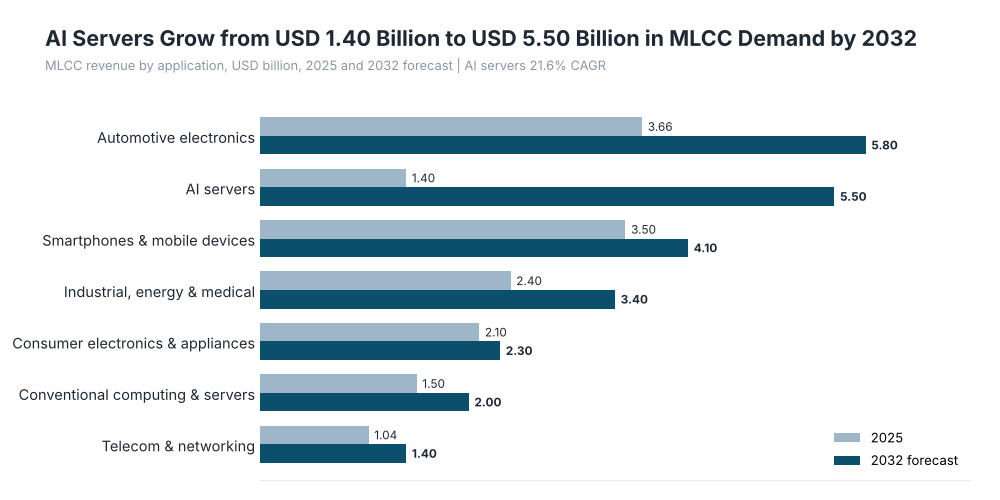
The AI server MLCC segment was valued at approximately USD 1.40 billion in 2025 and is projected to reach USD 5.50 billion by 2032, growing at a CAGR of 21.6%, according to MarketsandStats. Increasing demand for high-capacitance MLCCs in advanced servers, processors and computing equipment is supporting rapid segment growth.
Taiyo Yuden reported JPY 251.8 billion in capacitor sales for the fiscal year ended March 2026, an increase of 8.5%, supported by IT infrastructure and automotive demand. Rising server production and growing demand for compact, high-capacitance capacitors are creating higher-value sales opportunities for leading MLCC manufacturers.
Smartphones and Mobile Devices: Major Contributor to MLCC Sales
The smartphone and mobile device MLCC segment generated approximately USD 3.50 billion in 2025, accounting for 22.4% of global revenue, and is projected to reach USD 4.10 billion by 2032, at a CAGR of 2.3%.
Smartphones, tablets and wearable devices remain major consumers of miniature MLCCs. Murata Manufacturing reported stronger capacitor sales to smartphone manufacturers in fiscal 2026, reflecting continued demand from mobile electronics. Growing adoption of compact, high-capacitance MLCCs in premium smartphones is supporting sales opportunities for manufacturers offering miniature components at competitive prices.
Automotive Electronics: Growing Demand for Automotive-Grade MLCCs
The automotive MLCC segment was valued at approximately USD 3.66 billion in 2025, representing 23.5% of global revenue, and is projected to reach USD 5.80 billion by 2032, growing at a CAGR of 6.8%.
Increasing adoption of electric vehicles, advanced driver-assistance systems (ADAS), electronic braking systems and connected vehicle technologies is driving demand for automotive-grade MLCCs. Manufacturers including Murata Manufacturing, TDK and Samsung Electro-Mechanics are expanding their presence in high-voltage, high-capacitance and high-reliability capacitors. Growing electronics content in vehicles is supporting long-term orders and higher-value automotive MLCC sales.
Industrial, Energy and Medical Electronics: Expanding Specialized MLCC Demand
The industrial, energy and medical electronics segment accounted for approximately USD 2.40 billion in 2025 and is projected to reach USD 3.40 billion by 2032, growing at a CAGR of 5.1%.
Increasing demand from industrial automation, robotics, motor drives, power equipment and medical devices is supporting specialized MLCC sales. TDK's fiscal 2026 results showed stronger ceramic capacitor sales in industrial applications, reflecting demand for reliable electronic components. Growing investment in industrial electronics and energy equipment is creating opportunities for high-voltage and high-reliability MLCC manufacturers.
Conventional Computing and Servers: Steady MLCC Revenue Growth
Conventional computing and server MLCC revenue was estimated at USD 1.50 billion in 2025 and is projected to reach USD 2.00 billion by 2032, at a CAGR of 4.2%.
Personal computers, conventional servers, storage systems and computing equipment continue to support MLCC demand. Increasing requirements for memory, processor power management and compact electronic components are contributing to sales of standard and higher-capacitance MLCCs.
Consumer Electronics and Appliances: High-Volume MLCC Consumption
The consumer electronics and appliances segment generated approximately USD 2.10 billion in 2025 and is projected to reach USD 2.30 billion by 2032, growing at a CAGR of 1.3%.
Televisions, gaming consoles, household appliances and other consumer devices remain important applications for standard MLCCs. Large-scale electronics manufacturing and continued integration of electronic controls are supporting demand, particularly for suppliers offering competitive pricing and high-volume production capabilities.
Telecom and Networking: Increasing Demand for Communication-Grade MLCCs
The telecom and networking MLCC segment was valued at approximately USD 1.04 billion in 2025 and is projected to reach USD 1.40 billion by 2032, expanding at a CAGR of 4.3%.
Investment in network infrastructure, communication equipment and high-speed data transmission systems is supporting MLCC demand. Network switches, routers, wireless infrastructure and telecom power equipment require standard and high-frequency capacitors, creating opportunities for manufacturers supplying communication-grade MLCCs.
How Are Dielectric, Voltage and Capacitance Requirements Influencing MLCC Sales?
Class II MLCCs Lead with 85.3% Market Share
The Class II MLCC segment was valued at approximately USD 13.30 billion in 2025, accounting for 85.3% of global revenue, and is projected to reach USD 21.25 billion by 2032, growing at a CAGR of 6.9%, according to MarketsandStats.
Strong demand for X5R and X7R capacitors in smartphones, servers, automotive electronics and industrial equipment is supporting segment growth. Murata Manufacturing, Samsung Electro-Mechanics and Taiyo Yuden are major suppliers of compact, high-capacitance Class II MLCCs, with growing demand for specialized products supporting higher-value sales.
Class I and other specialized dielectric MLCCs generated approximately USD 2.30 billion in 2025 and are projected to reach USD 3.25 billion by 2032, at a CAGR of 5.1%. Demand is concentrated in precision electronic equipment, radio-frequency applications and communication systems requiring stable capacitor performance.
Low-Voltage MLCCs Dominate, While High-Voltage Products Show Faster Growth
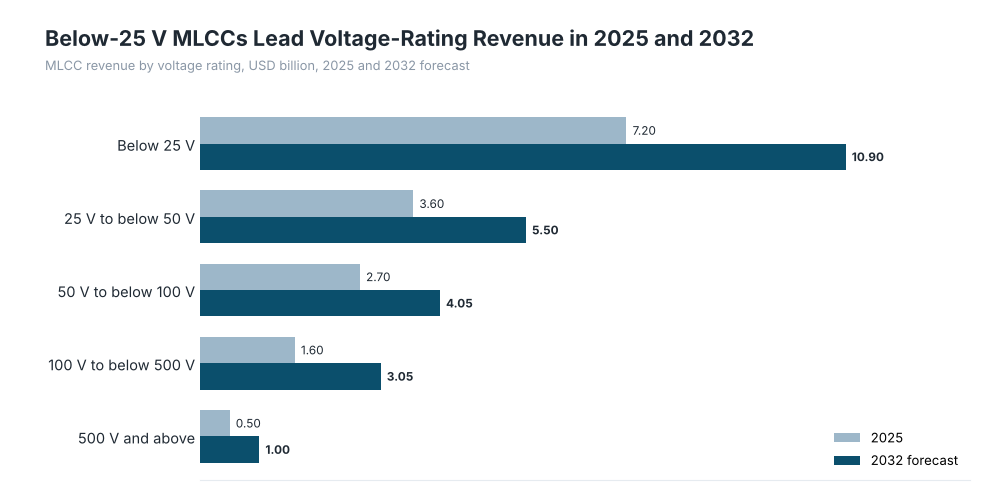
MLCCs rated below 25 V led the market with approximately USD 7.20 billion in revenue and a 46.2% share in 2025, with sales projected to reach USD 10.90 billion by 2032, growing at a CAGR of 6.1%. Smartphones, computers, processors and memory systems remain major applications for low-voltage capacitors.
The 25 V to below 50 V segment is projected to increase from USD 3.60 billion in 2025 to USD 5.50 billion by 2032, while the 50 V to below 100 V segment is expected to grow from USD 2.70 billion to USD 4.05 billion, supported by automotive electronics and industrial power equipment.
Higher-voltage MLCCs are expected to record stronger growth. The 100 V to below 500 V segment is projected to reach USD 3.05 billion by 2032, compared with USD 1.60 billion in 2025, at a CAGR of 9.7%. Meanwhile, MLCCs rated 500 V and above are projected to increase from USD 500 million to USD 1.00 billion by 2032, growing at approximately 10.4% annually.
Increasing adoption of electric vehicles, industrial power systems and advanced electronic controls is supporting high-voltage MLCC demand, creating revenue opportunities for manufacturers such as TDK, Murata Manufacturing and Samsung Electro-Mechanics.
High-Capacitance MLCCs Gain Demand in Servers and Automotive Electronics
Growing demand for MLCCs rated 10 µF and above is supporting sales of compact, high-capacitance capacitors used in advanced servers, automotive electronics and power management equipment.
In May 2026, Taiyo Yuden commercialized a 220 µF automotive-grade MLCC, highlighting growing demand for high-capacitance components in vehicle electronics. Manufacturers including Murata Manufacturing, Samsung Electro-Mechanics and Taiyo Yuden are expanding their advanced MLCC portfolios to serve automotive and computing customers.
Increasing demand for compact, high-capacitance products is creating opportunities for premium MLCC sales, particularly among manufacturers supplying specialized capacitors for advanced electronic applications.
How Are Manufacturing Costs and Production Capacity Affecting MLCC Competition?
Manufacturing costs, production efficiency and capacitor selling prices play an important role in MLCC manufacturer profitability. Growing demand for miniature, high-capacitance and automotive-grade MLCCs is encouraging leading suppliers to strengthen their production capabilities and expand specialized product offerings.
According to Yageo's 2025 annual report, the company generated NT$132.93 billion in consolidated revenue in 2025, with MLCCs contributing approximately 19%, equivalent to NT$25.26 billion. Its manufacturing capabilities in ceramic materials, electrode materials and production equipment support competitive costs and consistent product quality.
Murata Manufacturing also reported improved operating profitability in fiscal 2026, supported by higher factory utilization, despite lower product prices. These developments highlight the importance of manufacturing efficiency, specialized MLCC sales and competitive production costs in supporting profitability.
Where Are the Major MLCC Manufacturing and Customer Markets Located?
Japan: Leading Center for Advanced MLCC Manufacturing
Japan maintains a strong position in global MLCC manufacturing through Murata Manufacturing, TDK Corporation and Taiyo Yuden. These companies supply miniature, high-capacitance and automotive-grade MLCCs to electronics manufacturers worldwide.
Murata reported JPY 936.4 billion in capacitor revenue in fiscal 2026, while Taiyo Yuden recorded JPY 251.8 billion in capacitor sales, reflecting the global scale of Japanese suppliers. Growing demand from automotive electronics, servers and industrial equipment is supporting their specialized MLCC businesses.
South Korea: Expanding Specialized MLCC Production
South Korea's MLCC industry is led by Samsung Electro-Mechanics, a major supplier of capacitors for servers, smartphones and automotive electronics.
In September 2026, the company announced a KRW 1.0722 trillion (approximately USD 780 million) AI server MLCC supply agreement for 2027, highlighting its expanding position in high-capacitance capacitors. Increasing demand for advanced server and automotive MLCCs is supporting higher-value sales opportunities for South Korean manufacturers.
Taiwan and China: Large-Scale MLCC Manufacturing
Taiwan and China are important manufacturing centers for standard and specialized MLCCs. Key manufacturers include Yageo Group, Walsin Technology and Guangdong Fenghua Advanced Technology.
Yageo generated approximately NT$25.26 billion in MLCC revenue in 2025, supported by its established passive-component manufacturing operations. Strong electronics production, competitive manufacturing costs and demand from consumer and industrial customers continue to support MLCC manufacturing across both markets.
North America and Europe: Demand from Computing, Automotive and Industrial Applications
North America represents an important customer market for MLCCs used in data centers, advanced computing equipment, automotive electronics and industrial systems. Increasing demand for high-capacitance capacitors in server infrastructure is creating opportunities for global MLCC suppliers.
Europe's MLCC demand is supported by automotive manufacturing, factory automation, renewable energy equipment and industrial electronics. Growing requirements for automotive-grade, high-voltage and high-reliability capacitors are supporting specialized MLCC sales.
Which Companies Lead the Global MLCC Market?
The global MLCC market includes Murata Manufacturing, Samsung Electro-Mechanics, TDK Corporation, Taiyo Yuden, Yageo Group, Walsin Technology, Kyocera AVX, Vishay Intertechnology and Guangdong Fenghua Advanced Technology.
- Murata Manufacturing (Japan): Reported JPY 936.4 billion in capacitor revenue in fiscal 2026, increasing 12.6%, supported by smartphone and server demand. The company maintains a strong position in miniature, high-capacitance and automotive-grade MLCCs.
- Samsung Electro-Mechanics (South Korea): Recorded approximately KRW 5.20 trillion in component business revenue in 2025 and announced a KRW 1.0722 trillion AI server MLCC supply agreement for 2027, strengthening its position in specialized computing capacitors.
- Taiyo Yuden (Japan): Reported JPY 251.8 billion in capacitor sales in fiscal 2026, up 8.5%, supported by automotive and IT infrastructure demand. The company continues expanding its high-capacitance MLCC offerings.
- TDK Corporation (Japan): Supplies automotive-grade and industrial ceramic capacitors. Its fiscal 2026 results showed stronger sales in these applications, alongside profitability pressure from declining average selling prices.
- Yageo Group (Taiwan): Generated approximately NT$25.26 billion in MLCC revenue in 2025, supported by a diversified passive-component portfolio and large-scale manufacturing capabilities.
- Walsin Technology (Taiwan), Kyocera AVX (United States), Vishay Intertechnology (United States) and Guangdong Fenghua Advanced Technology (China): Compete across consumer electronics, automotive, industrial and specialized MLCC applications.
Increasing demand for high-capacitance, high-voltage and automotive-grade MLCCs is strengthening competition among manufacturers offering advanced products, competitive pricing and reliable production capacity.
Analyst Perspective: Specialized MLCCs Are Supporting Higher-Value Market Growth
The global MLCC market is projected to grow from USD 15.60 billion in 2025 to USD 24.50 billion by 2032, at a CAGR of approximately 6.7%, according to MarketsandStats. Rising demand from advanced servers, automotive electronics and industrial equipment is supporting growth in specialized MLCC categories.
Samsung Electro-Mechanics' approximately USD 780 million server MLCC supply agreement for 2027 demonstrates the growing revenue potential of high-capacitance capacitors and long-term customer contracts. Meanwhile, Murata's improving factory utilization and Yageo's manufacturing capabilities highlight the importance of production efficiency in maintaining competitive profitability.
Through 2032, high-capacitance, high-voltage and automotive-grade MLCCs are expected to offer some of the strongest revenue opportunities. Manufacturers combining specialized product portfolios, efficient production and established customer relationships are positioned to benefit from increasing capacitor demand across computing, automotive and industrial applications.