

High Voltage Capacitor Market (2026-2032)
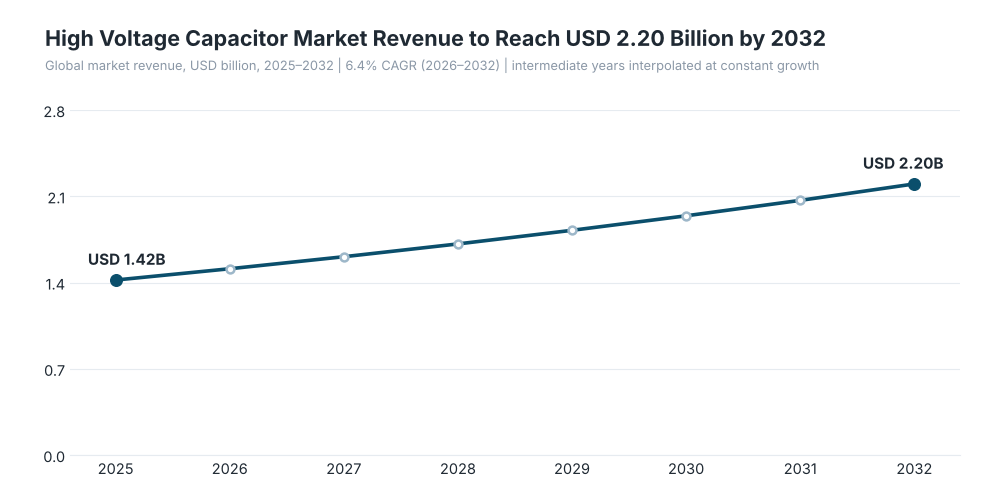
The global High Voltage Capacitor Market was valued at approximately USD 1.42 billion in 2025 and is projected to reach USD 2.20 billion by 2032, expanding at a CAGR of 6.4% during 2026-2032.



Quick Enquiry
High Voltage Capacitor Market: Application Demand, Regional Growth, Technology Developments, and Competitive Outlook
According to MarketsandStats, the global High Voltage Capacitor Market was valued at approximately USD 1.42 billion in 2025 and is projected to reach USD 2.20 billion by 2032, expanding at a CAGR of 6.4% during 2026-2032. Growth is closely linked to transmission network development, reactive-power compensation, industrial power-quality requirements, HVDC converter stations, and the replacement of aging capacitor equipment.
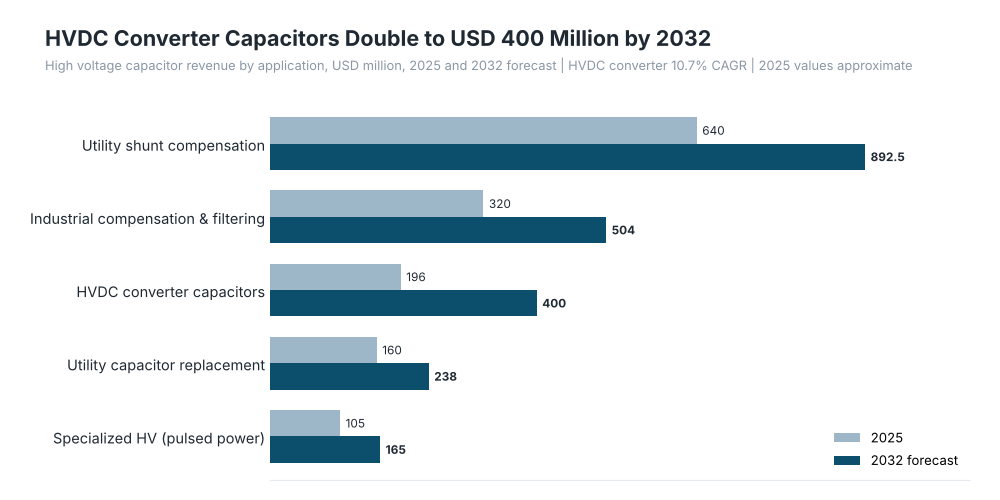
Utility shunt compensation accounted for approximately 45.0% of global revenue in 2025, making it the largest application. Industrial compensation and filtering represented another substantial market, while HVDC converter-related capacitors are expected to record the fastest growth through 2032. Utility capacitor banks remain widely used for voltage regulation and reactive-power management, whereas HVDC projects require specialized capacitor equipment for converter and filtering applications.
According to GE Vernova, its high-voltage capacitor business serves more than 1,000 customers across 80 countries, reflecting the established international presence of capacitor technology in electricity infrastructure. Large transmission projects, industrial electrification, and the continued operation of existing substations sustain demand across both conventional and specialized high-voltage capacitor applications.
What Are the Major Growth Drivers in the High Voltage Capacitor Market?
Utility Substation Expansion Sustains Shunt Capacitor Demand
New utility shunt compensation installations generated approximately USD 640 million in 2025 and are projected to reach USD 892.5 million by 2032, growing at a CAGR of 4.9%. Capacitor banks are extensively used in transmission and distribution substations to maintain voltage levels, improve power factors, and manage reactive-power flows. Their established role in electricity networks accounts for their substantial contribution to market revenue.
GE Vernova manufactures high-voltage capacitor units rated between 25 and 1,100 kVAR, including three-phase products operating at 2.4–25 kV. Its internally fused, externally fused, and fuseless configurations address different utility and industrial applications. These product offerings illustrate the range of capacitor requirements across conventional substations and larger compensation installations, where equipment reliability and long service life remain central operating considerations.
Industrial Power Quality Requirements Support Specialized Applications
Industrial compensation and harmonic filtering accounted for approximately USD 320 million in 2025 and are projected to reach USD 504 million by 2032, expanding at a CAGR of 6.7%. Steel production, mining, heavy machinery, and large motor-driven industrial facilities represent important applications where voltage fluctuations and harmonic distortion can affect equipment performance and production efficiency.
Industrial capacitor systems help manage reactive power and electrical disturbances associated with large industrial loads. Harmonic filtering applications generally require greater attention to electrical loading and operating conditions than conventional shunt compensation. This supports demand for specialized capacitor products, particularly in energy-intensive industries where power-quality problems can increase maintenance expenses and disrupt production.
HVDC Transmission Development Accelerates Specialized Capacitor Growth
HVDC converter-related capacitors generated an estimated USD 196 million in 2025 and are projected to reach USD 400 million by 2032, registering a CAGR of 10.7%. Long-distance transmission projects and interregional electricity connections are expanding the use of converter-associated capacitors and harmonic filtering equipment.
Major HVDC developments, including Brazil's Rio Madeira system and Canada's Lower Churchill transmission project, demonstrate the application of power capacitors in large electricity networks. These installations require equipment capable of delivering consistent performance under demanding electrical conditions.
Compared with conventional utility compensation, HVDC applications involve more extensive equipment qualification and project-specific performance requirements. Manufacturers with experience in high-voltage insulation, dielectric reliability, and converter-related electrical equipment therefore have opportunities to compete in a specialized and faster-growing part of the market.
How Are Capacitor Replacement and Specialized Applications Contributing to Market Revenue?
Aging Electricity Infrastructure Supports Recurring Replacement Demand
Replacement of existing utility capacitor units represented approximately USD 160 million in 2025 and is projected to reach USD 238 million by 2032, growing at a CAGR of 5.8%. Capacitor deterioration, equipment failures, and substation refurbishment contribute to recurring replacement requirements across established transmission and distribution networks.
Replacement activity is particularly relevant in mature electricity markets where capacitor banks have operated for extended periods. Utilities renew capacitor units to maintain voltage-support capabilities and reduce the likelihood of equipment-related interruptions. Compatibility with existing electrical installations and proven operating reliability remain important, supporting continued demand for established utility-grade capacitor products.
Pulsed-Power and Energy-Storage Applications Support Specialized Capacitors
Specialized high-voltage capacitors accounted for approximately USD 105 million in 2025, with revenue projected to reach USD 165 million by 2032, expanding at a CAGR of 6.7%. Pulsed-power equipment, high-voltage discharge systems, and specialized energy-storage applications require capacitors designed for demanding electrical operating conditions.
Unlike utility shunt capacitors, these products are designed for applications involving controlled energy discharge and high electrical stress. Their manufacturing and testing requirements create opportunities for companies with specialized high-voltage engineering capabilities. Product performance and application-specific reliability are important competitive factors in this market.
How Are Dielectric Technologies Influencing High Voltage Capacitor Development?
All-Film Dielectric Technology Remains Important in Utility Capacitors
All-film dielectric technology remains widely used in utility-grade high-voltage capacitors because of its established electrical performance and suitability for reactive-power compensation. Manufacturers offer different dielectric systems and capacitor constructions to meet the requirements of transmission substations, industrial installations, and filtering equipment.
Hitachi Energy provides high-voltage capacitor and filtering systems for utility and industrial applications where electrical reliability and operating efficiency are essential. The continued use of established dielectric technologies reflects the importance of predictable equipment performance across infrastructure with long operating lives.
Advanced Dielectric Materials Target Compact and High-Temperature Applications
Advanced polymer dielectric materials are being developed to improve thermal performance, energy density, and capacitor dimensions. Such improvements are relevant to specialized high-voltage power equipment where thermal conditions and available installation space influence equipment design.
Peak Nano has developed NanoPlex dielectric film with a reported temperature capability of up to 135°C. The technology demonstrates progress in high-performance capacitor materials, particularly for applications requiring improved thermal resilience. Wider adoption in utility and industrial high-voltage equipment will depend on electrical qualification, manufacturing consistency, and long-term operating reliability.
Which Countries Offer the Strongest Growth Opportunities in the High Voltage Capacitor Market?
China - Largest National Market Supported by Transmission Expansion
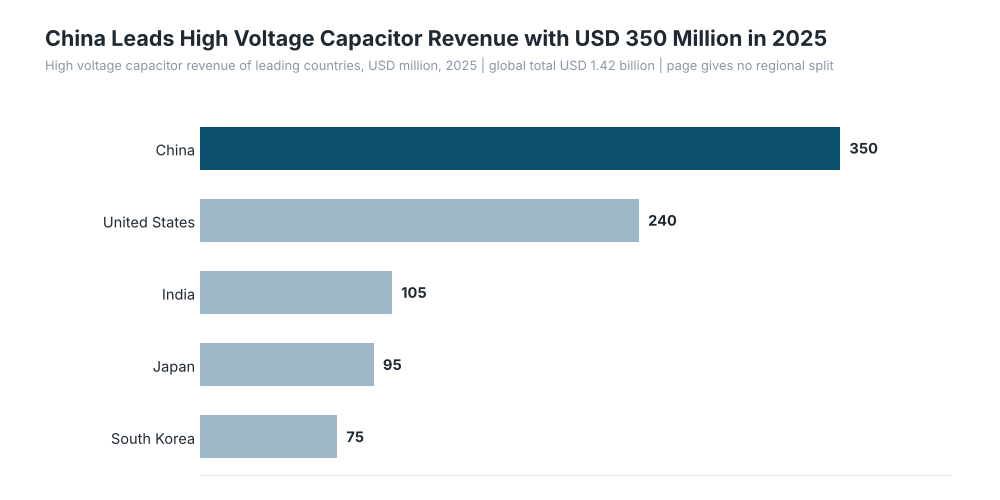
China's High Voltage Capacitor Market was estimated at USD 350 million in 2025 and is projected to reach USD 590 million by 2032, growing at a CAGR of 7.7%. The country's extensive transmission network and continued substation development support applications in reactive-power compensation, voltage regulation, and specialized converter infrastructure.
According to China's National Bureau of Statistics, newly added transformer equipment rated at 220 kV and above represented approximately 320.43 million kVA of capacity in 2025. The scale of this expansion highlights substantial development of high-voltage electricity infrastructure, where capacitor banks are incorporated when required for voltage regulation and reactive-power compensation.
China's established electrical equipment manufacturing industry also influences competition. Domestic suppliers benefit from local manufacturing capabilities and established utility relationships, while international manufacturers compete in applications requiring specialized equipment and proven high-voltage performance.
United States - Utility Modernization and Equipment Replacement Support Growth
The United States High Voltage Capacitor Market generated approximately USD 240 million in 2025 and is projected to reach USD 350 million by 2032, at a CAGR of 5.5%. Transmission network reinforcement, substation modernization, and replacement of aging capacitor installations remain important sources of market demand.
A documented 533 kV capacitor-bank installation in California's Mojave Desert incorporated separate banks rated at 226 MVAr and 170 MVAr, demonstrating the scale of reactive-power compensation used in American transmission infrastructure.
Existing capacitor banks also require periodic equipment renewal, supporting replacement activity alongside new transmission projects. The country's extensive utility infrastructure provides an established market for high-voltage capacitors designed for reliable operation and compatibility with existing electrical systems.
Japan - Interregional Transmission Development Supports High-Reliability Equipment
Japan's High Voltage Capacitor Market was valued at approximately USD 95 million in 2025 and is projected to reach USD 142 million by 2032, expanding at a CAGR of 5.9%. Interregional transmission reinforcement and electricity supply reliability remain important priorities influencing capacitor applications.
According to the Japan Electric Power Information Center, the country's cross-regional grid master plan includes approximately JPY 7 trillion in proposed network reinforcement under its base scenario. The plan identifies 4 GW of transmission reinforcement between Hokkaido, Tohoku, and Tokyo, including HVDC development.
These projects create opportunities for high-voltage capacitors used in converter filtering and voltage-support systems where specified. Japan's emphasis on equipment durability and dependable electrical infrastructure also supports manufacturers with established product qualifications and proven operating performance.
South Korea - HVDC Infrastructure Supports Specialized Capacitor Applications
South Korea's High Voltage Capacitor Market was estimated at USD 75 million in 2025 and is projected to reach USD 120 million by 2032, growing at a CAGR of 6.9%. HVDC transmission development, electricity network reinforcement, and industrial power-quality requirements are important factors supporting the market.
KEPCO's HVDC infrastructure includes documented capacitor-related equipment applications, demonstrating the role of high-voltage capacitors in the country's transmission network. Continued development of converter-based electricity infrastructure supports opportunities for capacitor equipment used in harmonic filtering and voltage compensation.
South Korea's established electrical equipment manufacturing capabilities also contribute to its position in specialized high-voltage power infrastructure, where reliable electrical performance and project-specific equipment requirements are important.
India - Transmission Expansion Supports Above-Market Growth
India's High Voltage Capacitor Market was estimated at USD 105 million in 2025 and is projected to reach USD 180 million by 2032, expanding at a CAGR of approximately 8.0%. Electricity transmission expansion, new substations, and industrial electrification are contributing to the country's growing requirements for voltage-support and power-quality equipment.
Utility capacitor banks support reactive-power management across transmission networks, while industrial compensation and filtering systems serve electricity-intensive manufacturing facilities. India's relatively strong projected growth reflects opportunities associated with expanding electricity infrastructure and industrial power requirements.
Which Companies Lead Competition in the High Voltage Capacitor Market?
GE Vernova, Hitachi Energy, General Atomics, ELECTRONICON, Eaton, TDK Corporation, Vishay Intertechnology, and Yageo participate in different categories of high-voltage capacitors and related electrical equipment. Their competitive positions vary according to application, voltage ratings, electrical performance, and manufacturing capabilities.
GE Vernova and Hitachi Energy have established portfolios serving utility compensation, industrial power quality, and high-voltage transmission applications. Their involvement in large electricity infrastructure projects supports their presence in capacitor banks, filtering equipment, and associated electrical systems.
General Atomics specializes in high-voltage energy-storage and pulsed-power capacitors, including products rated from 100 kV to 2 MV. These products serve applications requiring specialized electrical discharge performance and high-voltage reliability.
ELECTRONICON participates in industrial power capacitor manufacturing, while TDK, Vishay, and Yageo serve selected high-voltage electronic component applications. Their product portfolios address different voltage and equipment requirements from large utility compensation systems, making application-specific comparisons important when assessing the competitive landscape.
In utility compensation, manufacturers compete through electrical reliability, manufacturing quality, equipment longevity, and competitive production costs. HVDC and specialized industrial applications offer greater scope for differentiation because of demanding performance requirements and extensive qualification processes.
Analyst Perspective: Can HVDC Capacitors Deliver Better Margins Than Conventional Utility Capacitors?
MarketsandStats expects profitability in the High Voltage Capacitor Market to depend increasingly on product specialization rather than production volume. HVDC-related capacitor revenue is projected to grow at 10.7% annually through 2032, compared with 4.9% for utility shunt compensation. Specialized HVDC capacitors may command higher prices, although greater qualification costs and project-specific requirements could affect profitability.
We see replacement capacitors as an attractive source of recurring revenue, particularly for established manufacturers with approved utility-grade products. Long-standing utility relationships can provide a competitive advantage, while increasing competition among conventional capacitor manufacturers, particularly in China, may place pressure on pricing and margins.
MarketsandStats anticipates stronger opportunities for manufacturers specializing in HVDC capacitors, industrial harmonic filtering, and high-reliability utility equipment. Companies with established customer relationships and differentiated product portfolios are better positioned to capture higher-value applications while maintaining stable revenue from conventional capacitor markets.