

Digital Remittance Market (2026-2032)
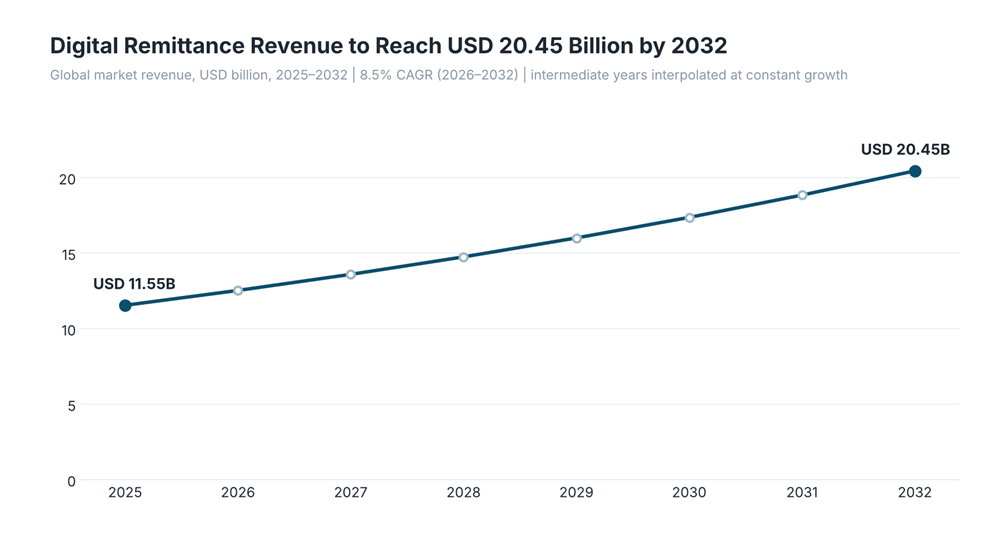
The Global Digital Remittance Market was estimated at USD 11.55 billion in 2025 and is projected to reach approximately USD 20.45 billion by 2032, expanding at an estimated CAGR of 8.5% during 2026-2032.



Quick Enquiry
How Are Digital Money Transfers, Migrant Remittances, and Lower Transaction Costs Transforming the Global Digital Remittance Market?
The Global Digital Remittance Market was estimated at USD 11.55 billion in 2025 and is projected to reach approximately USD 20.45 billion by 2032, expanding at an estimated CAGR of 8.5% during 2026-2032, according to MarketsandStats. Global digitally initiated personal remittances represented an estimated USD 481.35 billion in transferred funds across approximately 1.10 billion transactions in 2025. Mobile applications accounted for the largest share of estimated digital remittance revenue, while family and personal support remained the primary reason for international money transfers.
International migration and household financial support provide a substantial base for recurring remittances. According to Visa's Money Travels 2025 report, global peer-to-peer cross-border remittance flows reached approximately USD 905 billion in 2024, compared with USD 865 billion in 2023. The report surveyed more than 44,000 remittance senders and receivers across 20 countries and found that 67% preferred sending money to a bank account through a digital application. This preference provides opportunities for remittance companies to expand transaction volumes through mobile platforms rather than relying entirely on cash-based agent networks.
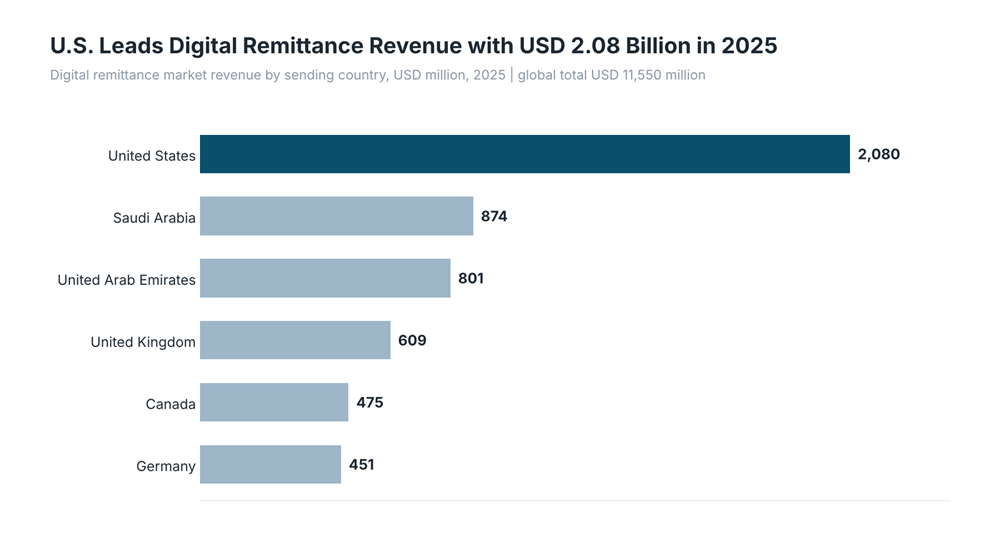
Digital remittance providers generate revenue through transfer charges and foreign exchange margins. The average revenue earned per transaction was estimated at USD 10.50 in 2025, although actual earnings differ across providers and payment corridors. The United States represented the largest estimated national revenue market at USD 2.08 billion, followed by important sending markets including Saudi Arabia, the United Arab Emirates, the United Kingdom, and Canada. India, Mexico, and the Philippines remained major receiving markets, supporting substantial cross-border payment activity.
Why Are Lower Transfer Costs Increasing Competition Between Digital Remittance Providers?
The cost of transferring money internationally remains an important factor influencing customer choice, particularly among migrant workers sending relatively small amounts to their families. Digital remittance companies compete through transfer fees, exchange rates, transaction speed, and the ability to deliver funds directly into bank accounts or mobile wallets.
According to the World Bank's Remittance Prices Worldwide report for Q3 2025, the average cost of sending USD 200 through digital remittance services was 4.59%, compared with 7.30% for non-digital services. Banks acting as remittance service providers recorded an average cost of 14.99%. These differences favor digital providers in price-sensitive payment corridors, although bank-funded transfers offered by specialist digital companies can carry substantially lower charges than traditional bank remittance services.
Lower transfer prices are also changing how companies generate revenue. Remitly reported that its money transfer volume increased 37% to USD 74.9 billion in 2025, while revenue increased 29% to approximately USD 1.635 billion. The difference indicates that growing transfer volumes do not always produce revenue increases at the same rate. Higher transaction volumes do not necessarily improve margins when customer acquisition, payment processing, and compliance expenses absorb much of the additional revenue.
The Financial Stability Board's cross-border payment targets call for reducing the global average remittance cost to 3% by 2030, with no corridor exceeding 5%. This creates additional pressure on transfer pricing, particularly in markets where traditional operators continue to charge higher fees. Falling transfer charges also make operating costs and repeat transaction volumes more significant to provider profitability.
How Is the United States Maintaining Its Position as the Largest Digital Remittance Revenue Market?
The United States Digital Remittance Market was estimated at approximately USD 2.08 billion in 2025, accounting for nearly 18.0% of global market revenue. Annual digitally initiated remittance transactions were estimated at approximately 160 million, supported by migrant workers, expatriate communities, and households sending financial assistance to relatives overseas. Important receiving destinations for U.S.-originated transfers include Mexico, India, the Philippines, and several Central American countries.
The strength of the U.S. market is evident in Remitly's financial disclosures. According to the company's 2025 Form 10-K, Remitly generated USD 1.083 billion in revenue from customers located in the United States, compared with approximately USD 825.8 million in 2024. Its U.S. revenue increased by approximately 31%, demonstrating substantial growth in digitally initiated cross-border payments.
Consumer preferences also favor digital channels. Visa's 2025 North American remittance research found that 69% of surveyed U.S. respondents preferred digital applications for sending remittances, while 61% preferred receiving funds through digital applications. Established providers are responding by expanding mobile transfer services and competing with digital-first companies on convenience, pricing, and reliability.
A regulatory development is also affecting remittance funding. Beginning January 2026, the United States introduced a 1% tax on certain international remittances funded through cash and specified physical instruments, according to the Internal Revenue Service. Transfers funded through qualifying financial accounts or U.S.-issued debit and credit cards are generally outside the tax. The tax increases the cost of certain cash-funded international remittances, while qualifying bank-account and U.S.-issued card-funded transfers are generally exempt.
Why Are Saudi Arabia and the United Arab Emirates Important Revenue Markets for Digital Remittance Companies?
Saudi Arabia and the United Arab Emirates are major international remittance sending markets because of their large expatriate workforces and established payment relationships with South Asia, Southeast Asia, and other labor-sending regions.
The Saudi Arabia Digital Remittance Market was estimated at approximately USD 874 million in 2025. According to Saudi Central Bank statistics, personal remittances by expatriates reached SAR 165.5 billion, approximately USD 44.1 billion, in 2025, increasing 15% from the previous year. Personal remittances by Saudi nationals contributed another SAR 70.4 billion. These substantial outward payment flows create recurring business opportunities for digital remittance providers operating across corridors connecting Saudi Arabia with India, Pakistan, Bangladesh, and the Philippines.
The United Arab Emirates Digital Remittance Market was estimated at approximately USD 801 million in 2025. The Central Bank of the UAE reported AED 99.8 billion in outward personal remittances through exchange houses during 2024, demonstrating the importance of established remittance networks. Digital providers are competing for customers who traditionally relied on physical exchange houses by offering mobile transfers, account-based payments, and more transparent exchange rates.
Visa's September 2025 UAE remittance study found that nearly two-thirds of surveyed consumers preferred sending remittances through digital applications. Ease of use was cited by 50% of respondents, while 46% highlighted safety, privacy, and transaction speed. These findings indicate strong consumer interest in mobile-based services, although traditional exchange houses remain important for cash-dependent customers.
Saudi Arabia recorded approximately USD 44.1 billion in expatriate remittances during 2025. The substantial transfer activity attracts digital providers, but competition on exchange rates and the cost of local payout arrangements can affect earnings.
How Are the United Kingdom, Germany, and Canada Supporting Digital Remittance Revenue?
Europe and North America contain established remittance sending markets with growing competition between digital-first providers, banks, and traditional money transfer operators.
The United Kingdom Digital Remittance Market was estimated at approximately USD 609 million in 2025, while Germany accounted for approximately USD 451 million. Both markets benefit from international migrant populations and regular transfers to Asia, Africa, and Eastern Europe. Digital providers compete by offering lower foreign exchange margins and convenient recurring payments, particularly to customers supporting relatives abroad.
Wise provides an important example of competitive pricing in international digital transfers. During its financial year ended March 2025, Wise processed GBP 106.4 billion in personal cross-border transfers, with its personal cross-border take rate declining from 0.72% to 0.63%. The company continued reducing cross-border pricing in FY2026, when its personal take rate fell to 0.57%. Its international transfer activity includes a broader range of personal payments than conventional migrant remittances, but its pricing performance demonstrates the pressure that digital payment providers place on transfer margins.
The Canada Digital Remittance Market was estimated at approximately USD 475 million in 2025. Remitly reported USD 163.8 million in revenue from Canadian customers during 2025, increasing from USD 141.1 million in 2024. The company's performance indicates continued expansion of digital remittance services among Canadian senders.
Many customers send money to the same family members every month. Competitive fees may attract them initially, but delivery delays, unexpected charges, or poor service can affect whether they continue using the same provider. Frequent transactions provide recurring fee income, although competition can reduce the amount earned on individual transfers.
How Are India, Mexico, and the Philippines Influencing Digital Remittance Demand?
Receiving countries play an important role in determining transfer frequency, payment destinations, and the methods used to deliver funds. India, Mexico, and the Philippines are particularly important because large overseas communities send money home regularly.
India remained the world's largest recipient of remittances, receiving approximately USD 135.4 billion during FY2024–25, according to the Government of India's Economic Survey 2025–26. These funds support household spending, education, housing, and other financial needs. Transfers from Gulf countries, North America, and Europe create business opportunities for providers offering direct bank deposits and mobile-based remittance services.
Mexico received approximately USD 62.47 billion in remittances during 2025, according to Banco de México. The country recorded 158.61 million remittance transactions, with an average transfer value of USD 394. Electronic transfers accounted for approximately USD 61.89 billion of the total. Although electronically delivered payments may originate through both digital platforms and physical agents, the substantial transaction volume makes Mexico an important market for banks and digital payout services.
The Philippines received approximately USD 39.62 billion in personal remittances during 2025, increasing 3.3% from the previous year, according to figures reported by the Bangko Sentral ng Pilipinas. The United States accounted for the largest share of these inflows, followed by Singapore, Saudi Arabia, Japan, the United Kingdom, and the UAE.
The financial importance of these receiving markets encourages remittance providers to establish bank, wallet, and cash payout arrangements. Cash pickup remains relevant in areas where access to formal banking is limited. Digital remittance providers continue supporting this option alongside bank and wallet transfers.
Which Digital Channels, Transfer Purposes, Payment Methods, and Service Providers Generate the Most Revenue?
By Digital Channel, mobile applications represented the largest segment of the Global Digital Remittance Market, generating an estimated USD 6.67 billion in 2025, equivalent to approximately 57.8% of total revenue. Web-based platforms accounted for approximately USD 2.82 billion, while online banking platforms generated USD 2.06 billion. Mobile applications benefit from repeat usage and convenient access to stored payment details and existing recipients. Visa's 2025 global survey found that 67% of respondents preferred app-based transfers to bank accounts, demonstrating the commercial importance of mobile services in remittance purchasing behavior.
By Transfer Purpose, family and personal support represented the leading category, contributing an estimated USD 9.31 billion in 2025, equivalent to approximately 80.6% of global digital remittance revenue. Education-related transfers generated approximately USD 900 million, followed by other personal transfers at USD 1.01 billion and medical-related payments at USD 330 million. Regular financial assistance to relatives remains an important source of recurring transactions, while education and medical transfers generally involve different payment frequencies and transfer values.
By Payment Method, bank-account-funded transfers accounted for the largest revenue contribution at approximately USD 5.49 billion in 2025, representing 47.5% of the market. Debit and credit card funding generated approximately USD 4.31 billion, while digital wallet funding represented USD 1.75 billion. Bank accounts support recurring transfers and established payment relationships, while card payments provide convenience for customers seeking immediate transfers. Digital wallets are increasingly relevant in markets with established mobile payment systems.
By Receiving Method, bank account deposits generated an estimated USD 6.76 billion in 2025, accounting for approximately 58.5% of digital remittance revenue. Cash pickup accounted for approximately USD 2.87 billion, while mobile wallet transfers contributed USD 1.92 billion. Bank deposits remain popular among recipients with established financial accounts, while mobile wallets and cash collection continue to serve customers who do not regularly use traditional banking services.
By Service Provider, digital-first remittance companies represented the leading category, generating an estimated USD 6.20 billion in 2025, equivalent to approximately 53.7% of global market revenue. Traditional money transfer operators offering digital services accounted for approximately USD 3.25 billion, while banks contributed USD 2.10 billion. Digital-first companies benefit from app-based customer relationships and international payment partnerships. Established operators compete through their agent networks and growing digital businesses, while banks maintain relationships with customers making international transfers through existing financial accounts.
By Remittance Type, outward remittances represent payments initiated from sending countries, while inward remittances represent funds received by destination countries. The United States, Saudi Arabia, UAE, United Kingdom, and Canada are important sending markets, while India, Mexico, the Philippines, Pakistan, and Bangladesh are significant receiving markets. The same international transfer is recorded as an outward payment in the sending country and an inward payment in the receiving country, making these complementary geographic perspectives rather than separate worldwide revenue pools.
Which Companies Are Shaping Competition in the Global Digital Remittance Industry?
Competition in the Digital Remittance Market is increasingly influenced by transaction pricing, customer retention, international payment coverage, and the ability to deliver money through bank accounts, digital wallets, and cash pickup networks.
Remitly is a prominent digital-first remittance provider. The company reported USD 1.635 billion in revenue during 2025, increasing 29% from 2024. Annual send volume reached USD 74.9 billion, while quarterly active customers increased to 9.3 million in Q4 2025, compared with 7.8 million a year earlier. Remitly's results demonstrate the commercial value of expanding customer relationships across international payment corridors.
Wise competes through international account services and lower cross-border transfer charges. Its GBP 106.4 billion in personal cross-border volume during FY2025 provides evidence of substantial consumer transfer activity. Declining take rates demonstrate the company's emphasis on lower transfer prices, while increasing transfer volume supports revenue opportunities across its wider international payments business.
Western Union remains an important competitor as it expands beyond traditional agent-based transfers. The company reported approximately USD 3.51 billion in Consumer Money Transfer revenue during 2025. Branded digital transactions accounted for 39% of Consumer Money Transfer transactions in Q4 2025, while branded digital revenue represented 30% of quarterly segment revenue. The figures indicate increasing digital participation within an established international remittance business.
Euronet Worldwide, through Ria Money Transfer, Xe, and related payment services, competes across physical and digital transfer channels. Its Money Transfer segment generated approximately USD 1.78 billion in revenue during 2025 and processed 183.4 million transactions. Direct-to-consumer digital transactions increased 30.8%, demonstrating the importance of online and app-based transfers within its broader business.
Zepz, which operates WorldRemit and Sendwave, reported processing more than USD 17 billion in transfers and over 120 million transactions during 2025. Its operations provide access to international remittance services across more than 130 countries. The company has also expanded its digital wallet offering, reinforcing competition in mobile-based international transfers.
Other relevant participants include MoneyGram, Paysend, Xoom, TerraPay, Thunes, and regional fintech providers. These companies serve different parts of the cross-border payment industry, including consumer remittances, payout infrastructure, digital wallets, and international payment connectivity.
Why Are Mobile Wallets and Bank Deposits Becoming Important to Remittance Distribution?
The receiving side of international money transfers is influencing competition because customers want recipients to access funds conveniently and securely. Bank deposits remain an important delivery method, but mobile wallets provide alternatives in countries where traditional financial account access is less widespread.
According to the GSMA State of the Industry Report on Mobile Money 2025, international remittances conducted through mobile money services reached USD 34 billion in 2024, increasing 22% from 2023. Sub-Saharan Africa accounted for more than 70% of the reported mobile money-enabled international remittance value, while South Asia recorded 62% annual growth.
This activity creates opportunities for digital remittance companies establishing relationships with local wallet providers and financial institutions. Access to multiple receiving methods can increase the number of customers served and improve the reliability of international payouts.
The commercial opportunity is particularly important in payment corridors connecting North America, Europe, and Gulf countries with recipients in Africa and Asia. Bank deposits remain widely used where recipients have established financial accounts, while cash pickup and mobile wallets serve customers who rely less on conventional banking services.
How Are Fraud Concerns, Transfer Regulations, and Exchange Rate Competition Affecting Industry Profitability?
As more customers use digital remittance platforms, security and trust have become important factors influencing provider selection. Fraudulent payment requests, account compromise, identity verification requirements, and uncertainty about transfer delivery can affect customer confidence and increase operating expenses.
Visa's Money Travels 2026 Digital Remittances Adoption Report, based on responses from more than 45,000 people across 20 countries, found that 69% of remittance users believed trust in a new money transfer method depended more on the provider than on the technology itself. The finding indicates that established reputations and customer protection measures can influence adoption, particularly when companies introduce new payment options.
Competitive pricing creates another challenge. Remittance companies must balance low transfer fees with foreign exchange income, payment processing costs, compliance expenses, and fraud losses. Providers charging lower prices may attract more transactions, but the resulting revenue benefit depends on transaction frequency and customer retention.
International regulation also affects operating conditions. Anti-money-laundering requirements, customer identification rules, sanctions screening, and country-specific transfer restrictions create compliance obligations across sending and receiving markets. For companies expanding into new countries, regulatory approval and reliable local partners remain important considerations.
The G20 target of reducing remittance costs to 3% by 2030 is expected to maintain pressure on expensive transfer corridors. Lower transfer fees are likely to intensify competition, particularly among providers serving customers who send relatively small amounts frequently.
How Are Consumer Trust and Recurring Transfer Activity Influencing the Market's Commercial Direction?
Many international remittance customers send money to the same recipients regularly, making repeat transactions an important part of provider revenue. Transfer fees and exchange rates influence their initial choice, while delivery reliability and the handling of payment problems can affect whether they return.
Remitly increased transfer volume by 37% in 2025, while Euronet recorded 30.8% growth in direct-to-consumer digital transactions. Western Union's growing branded digital share also reflects the movement of established money transfer businesses toward online services. These developments are intensifying competition between specialist digital providers and companies with long-established international agent networks.
Mobile applications have become an important channel for international transfers, with bank accounts widely used for funding and receiving payments. Falling transfer fees, however, are reducing the revenue providers can earn from individual transactions.
Analyst Commentary
"Pricing pressure is reducing the amount providers can earn from individual international transfers. Remitly's faster growth in transfer volume than revenue illustrates this shift. Companies handling frequent transactions face increasing pressure to control payment processing, customer acquisition, and compliance expenses as digital remittance services become more competitive."