

Chatbot in BFSI Market (2026-2032)
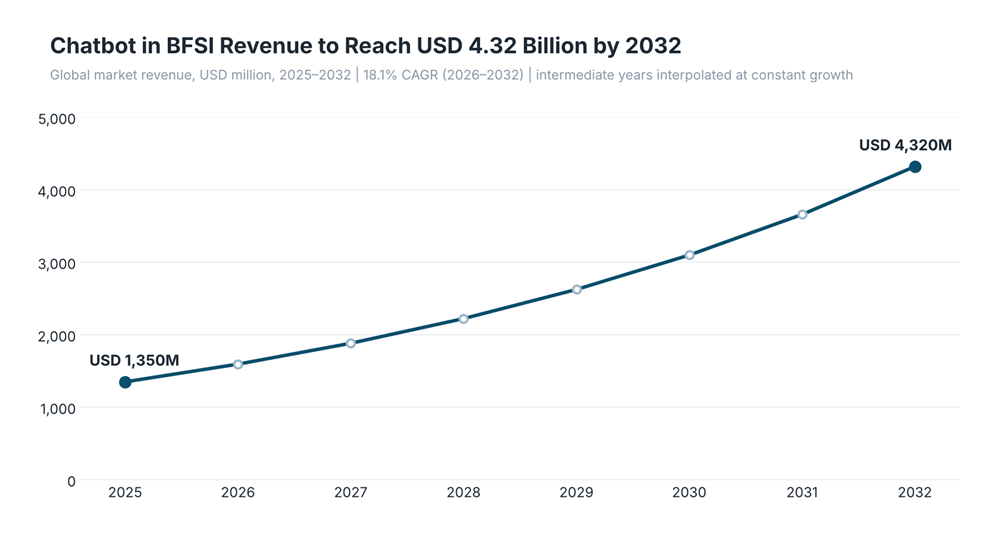
The Global Chatbot in BFSI Market was valued at an estimated USD 1.35 billion in 2025 and is projected to reach USD 4.32 billion by 2032, expanding at a CAGR of 18.1% during 2026-2032.



Quick Enquiry
Chatbot in BFSI Market: Banking Automation, Generative AI Adoption, and Financial Service Modernization Accelerate Global Growth
The Global Chatbot in BFSI Market was valued at an estimated USD 1.35 billion in 2025 and is projected to reach USD 4.32 billion by 2032, expanding at a CAGR of 18.1% during 2026–2032, according to MarketsandStats. Banking institutions accounted for the largest revenue share at 65.0%, equivalent to USD 877.5 million. NLP-based and traditional AI chatbots represented USD 715.5 million, while customer service and general inquiries contributed USD 513 million, reflecting the widespread adoption of conversational AI for banking support and customer interactions.
Financial institutions are increasing investments in chatbot platforms to automate customer inquiries, improve service availability and manage growing digital banking interactions. Generative AI is gaining traction as banks and insurers introduce more advanced virtual assistants for account servicing, payments, lending and insurance-related support.
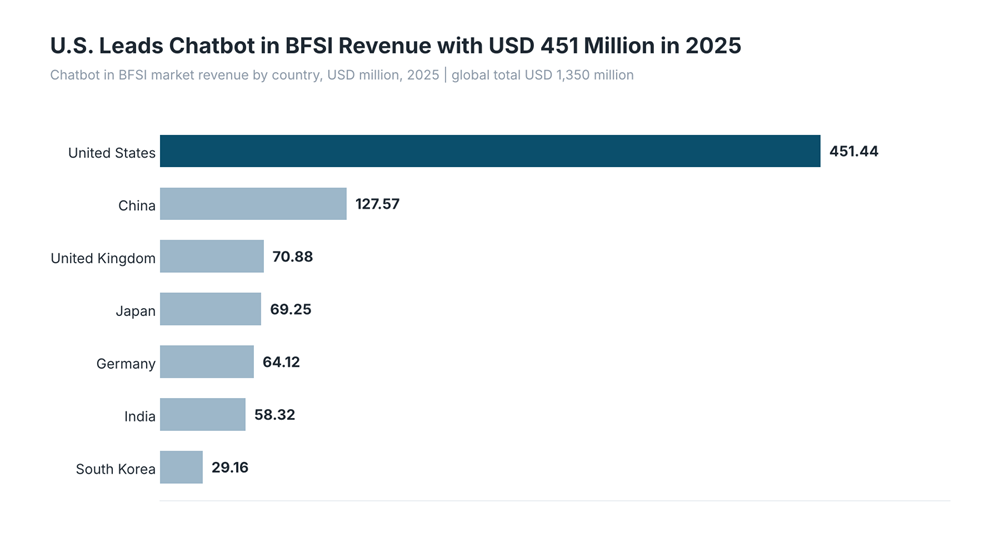
The United States led the global market with approximately USD 451.44 million in 2025, representing 33.4% of worldwide revenue. China followed at USD 127.57 million, while the United Kingdom and Japan contributed USD 70.88 million and USD 69.25 million, respectively. India, valued at USD 58.32 million, is expected to record one of the fastest country-level growth rates through 2032 as financial institutions expand AI-enabled customer service.
Major banks are already processing millions of customer interactions through conversational AI. Bank of America reported nearly 700 million interactions with its Erica virtual assistant during 2025, serving 20.6 million users. Since its launch in 2018, Erica has surpassed 3.2 billion customer interactions. The bank has also expanded conversational technology into corporate banking and wealth management, demonstrating its growing role beyond routine customer inquiries.
Adoption is also advancing across Europe and Asia. NatWest's Cora handled 12.9 million retail banking conversations in 2025, while Singapore-based DBS expanded its generative AI-powered DBS Joy assistant to more than 20,000 corporate and SME customers. Both developments highlight how conversational AI is becoming an established customer-service channel, encouraging continued investment in advanced chatbot capabilities across the financial services industry.
Key Report Takeaways Table
| Market Indicator | 2025 Position | 2032 Outlook |
|---|---|---|
| Global Market Revenue | USD 1.35 Billion | USD 4.32 Billion |
| Leading Chatbot Technology | NLP / Traditional AI — USD 715.50 Million | Generative AI / LLM — USD 2.76 Billion |
| Leading Deployment Mode | Cloud-Based — USD 958.50 Million | USD 3.59 Billion |
| Leading Interface | Text-Based — USD 1.07 Billion | USD 2.85 Billion |
| Leading Application | Customer Service & General Inquiries — USD 513 Million | USD 1.38 Billion |
| Leading End User | Banking Institutions — USD 877.50 Million | USD 2.55 Billion |
| Leading Region | North America — USD 513 Million | USD 1.51 Billion |
| Leading Country | United States — USD 451.44 Million | USD 1.32 Billion |
| Fastest-Growing Major Country | India | Approximately 24.9% CAGR |
Note - Market revenues and forecasts are MarketsandStats estimates. Company-reported adoption statistics cited in the discussion are separately sourced.
Why Does Customer Service Remain the Largest Revenue-Generating Application?
Customer service and general inquiries represented the largest application segment, accounting for 38.0% of global revenue, equivalent to USD 513 million in 2025, and are projected to reach USD 1.38 billion by 2032. Account and transaction assistance followed at USD 310.5 million, while loan and credit assistance contributed USD 175.5 million and insurance policy and claims support generated USD 162 million.
Customer service remains the leading application as banks increasingly use chatbots to handle everyday banking inquiries, card services, product information and customer support. Established virtual assistants are also being expanded across additional banking services, increasing their role in digital customer engagement and reducing dependence on conventional support channels.
NatWest's Cora handled 12.9 million retail banking conversations in 2025, with approximately 50% resolved without human intervention. The bank expanded its generative AI capabilities from four to 21 customer journeys, achieving an approximately 20-percentage-point improvement in automated query resolution compared with journeys without generative AI. The results highlight growing adoption of AI-powered customer service and the potential to reduce banking support costs.
Corporate banking is also seeing increased chatbot adoption. In November 2025, DBS expanded its DBS Joy virtual assistant to corporate and SME customers. Earlier trials recorded more than 120,000 unique chats, with approximately 4,000 corporate clients using the service monthly. Customer satisfaction improved by more than 23%, demonstrating the growing acceptance of AI-assisted support among business banking customers.
Loan and credit assistance, insurance policy servicing and wealth management are emerging as specialized chatbot applications. Financial institutions are extending conversational AI into these services to improve customer accessibility, accelerate routine inquiries and provide more personalized financial support, creating additional opportunities for chatbot software and service providers.
How Is Generative AI Reshaping Technology Adoption and Market Share in the BFSI Chatbot Industry?
NLP-based and traditional AI chatbots dominated the market with USD 715.5 million in 2025, accounting for 53.0% of global revenue. Generative AI and LLM-based chatbots followed at USD 378 million, representing 28.0%, while rule-based systems contributed USD 256.5 million.
Generative AI chatbots are projected to reach USD 2.76 billion by 2032, capturing 64.0% of global market revenue. Traditional NLP solutions are expected to generate USD 1.34 billion, while rule-based chatbot revenue is forecast to decline to USD 216 million. Financial institutions are increasingly adopting generative AI to improve conversational capabilities and expand automated banking services, although established NLP platforms continue to play an important role in customer support.
Major technology providers are upgrading existing banking assistants with generative AI capabilities. NatWest introduced Cora+ in collaboration with IBM, using watsonx Assistant and IBM Cloud to improve customer interactions across banking products and services. The development reflects continued investment in modernizing established chatbot platforms rather than replacing existing customer-service systems.
Specialized banking technology providers are also expanding their offerings. In August 2025, Kasisto launched KAIgentic, a generative AI platform designed for banks and credit unions to support customer interactions and employee assistance. The launch highlights increasing competition between specialized financial technology companies and established enterprise AI providers.
Generative AI adoption is expected to create significant opportunities for chatbot platform upgrades, enterprise subscriptions and integration services, as banks and insurers invest in more advanced conversational capabilities across customer-facing and internal operations.
Why Do Banks Account for Nearly Two-Thirds of Global Chatbot Expenditure?
Banking institutions dominated the global chatbot in BFSI market, generating USD 877.5 million in 2025, accounting for 65.0% of total revenue, and are projected to reach USD 2.55 billion by 2032. Insurance companies followed at USD 270 million, while fintech businesses, investment firms and other financial institutions collectively contributed USD 202.5 million.
Banks remain the largest adopters of conversational AI, with growing investments across retail banking, corporate services and wealth management. Major financial institutions are expanding virtual assistants beyond customer inquiries to support transactions, business banking and internal operations, strengthening the role of chatbots across digital banking services.
Bank of America has expanded its Erica technology across consumer banking, Merrill, Benefits OnLine and CashPro. The bank previously reported that more than half of its corporate clients used CashPro Chat during 2024, highlighting the growing adoption of conversational AI in corporate banking alongside established retail services.
Insurance companies are expected to represent an increasingly important growth opportunity, with chatbot revenue projected to reach USD 993.6 million by 2032. Insurers are investing in AI-powered assistants for policy servicing, claims communication, customer inquiries and employee support, with particular emphasis on improving service efficiency.
In February 2025, Allianz reported the use of its Insurance Copilot in claims operations, following its launch in Austria during 2024. The company also expanded its internal conversational AI capabilities through AllianzGPT, reflecting increasing investment in AI-assisted insurance operations and employee productivity.
Fintech companies, investment firms and other financial services institutions are projected to generate USD 777.6 million by 2032. Digital investment platforms, payment providers and non-banking lenders are expanding chatbot adoption to improve customer engagement and financial service accessibility, creating additional opportunities for conversational AI providers.
United States: The Largest National Market, Supported by Established Banking Virtual Assistants
The United States Chatbot in BFSI Market was valued at approximately USD 451.44 million in 2025 and is projected to reach USD 1.32 billion by 2032, growing at a CAGR of 16.5%. The country accounted for nearly 88% of North American revenue, supported by widespread chatbot adoption among major banks, credit unions and financial technology providers. Increasing investment in generative AI and digital customer service is further strengthening the country's position in conversational banking.
Bank of America remains a leading adopter, with its Erica virtual assistant recording nearly 700 million customer interactions in 2025. Operating since 2018, Erica has expanded across consumer banking, investment services and corporate financial platforms. Its large-scale adoption reflects the established role of AI-powered customer support in the U.S. banking industry.
American technology providers are also introducing more advanced conversational banking solutions. In August 2025, Kasisto launched KAIgentic, targeting banks and credit unions with generative AI capabilities for customer and employee assistance. IBM and Microsoft are also expanding their enterprise AI offerings for financial institutions, intensifying competition in banking automation and conversational AI services.
The United States is expected to remain the largest country market through 2032, with continued investment from commercial banks, credit unions, fintech companies and insurance providers supporting the expansion of AI-powered financial services.
China: Large-Scale AI Customer Service Positions the Country as Asia-Pacific's Largest Market
The China Chatbot in BFSI Market was valued at approximately USD 127.57 million in 2025 and is projected to reach USD 470.02 million by 2032, expanding at a CAGR of 20.5%. China accounted for approximately 35% of Asia-Pacific revenue, supported by growing adoption of AI-powered customer service across banking, insurance and integrated financial services.
Ping An Group reported approximately 1.70 billion customer-service interactions handled by AI representatives in 2025, accounting for 80% of its total customer-service volume, according to its March 2026 annual results announcement. The company also recorded approximately 90 million monthly active online customers and 251 million retail customers at year-end, highlighting the extensive use of digital financial services and AI-powered customer support in China.
United Kingdom: NatWest Establishes a Strong Reference for Commercial Banking Chatbots
The United Kingdom Chatbot in BFSI Market was valued at approximately USD 70.88 million in 2025 and is projected to reach USD 198.72 million by 2032, expanding at a CAGR of 15.9%. The country accounted for 21.0% of European market revenue, supported by increasing investment in AI-powered customer service and digital banking solutions.
NatWest's Cora virtual assistant handled 12.9 million customer conversations in 2025, with approximately 50% resolved without human intervention. The bank also reported 11.4 million mobile banking customers, highlighting the widespread adoption of digital financial services. Its expansion into AI-powered spending assistance reflects growing interest in personalized banking support.
British financial institutions are increasingly adopting conversational AI for customer inquiries, complaints handling and account management. The expansion of chatbot capabilities into financial guidance and everyday banking services is expected to support continued investment in advanced AI platforms across the UK financial sector.
Japan: Financial Institutions Expand Generative AI Beyond Internal Trials
The Japan Chatbot in BFSI Market was valued at approximately USD 69.25 million in 2025 and is projected to reach USD 235.01 million by 2032, expanding at a CAGR of 19.1%. Increasing adoption of generative AI among banks and financial institutions is supporting investment in advanced chatbot solutions for customer service and financial operations.
A September 2025 Bank of Japan survey of 153 financial institutions found that approximately 50% were already using generative AI, with adoption exceeding 70% when ongoing trials were included. The proportion reached 90% when institutions considering future adoption were also counted, reflecting strong interest in AI technologies across Japan's financial sector.
Japanese financial institutions are expanding AI applications across call-center support, customer inquiries, marketing and loan-document preparation. Positive assessments in customer-service efficiency and administrative operations are encouraging further investment, while data privacy and response accuracy remain important priorities for chatbot adoption.
India: Rapid Expansion in Conversational Payments and Multilingual Financial Services
The India Chatbot in BFSI Market was valued at approximately USD 58.32 million in 2025 and is projected to reach USD 276.48 million by 2032, expanding at a CAGR of 24.9%. India is expected to register one of the fastest growth rates among major country markets, supported by increasing investments in AI-powered banking services and the country's rapidly expanding digital payments ecosystem.
In October 2025, the National Payments Corporation of India (NPCI) introduced a pilot of its AI-powered UPI HELP assistant, offering conversational support for payment-related inquiries. At the time, UPI was processing approximately 20 billion transactions monthly, highlighting the substantial potential for automated customer assistance across India's digital financial services industry.
Indian banks and fintech companies are increasingly focusing on multilingual virtual assistants, transaction support and payment dispute resolution. The expansion of AI-powered assistance across mobile banking and digital payment platforms is expected to strengthen chatbot adoption, particularly among financial institutions serving large and linguistically diverse customer bases.
Germany and South Korea: Established Financial Institutions Advance Conversational AI
The Germany Chatbot in BFSI Market was valued at approximately USD 64.12 million in 2025 and is projected to reach USD 188.78 million by 2032, expanding at a CAGR of 16.7%. Germany remains one of Europe's major markets, supported by increasing investments in digital banking modernization and AI-powered insurance services.
Germany-headquartered Allianz has expanded its conversational AI capabilities through AllianzGPT and Insurance Copilot, supporting employee assistance and claims management. The latter was initially introduced for automotive claims operations in Austria. The company's investments highlight growing opportunities for AI-powered automation in the insurance industry, particularly in claims processing and internal customer support.
The South Korea Chatbot in BFSI Market was valued at approximately USD 29.16 million in 2025 and is projected to reach USD 110.59 million by 2032, registering a CAGR of 20.9%. Increasing adoption of AI-powered customer service and advanced digital banking platforms is contributing to market expansion.
In October 2025, KB Financial Group's research institute published an assessment of AI-assisted financial consultation, examining collaboration between virtual assistants and human representatives. The research highlighted the importance of service quality and human involvement in complex financial interactions, reflecting the industry's growing interest in reliable conversational banking solutions.
Financial institutions in both countries are prioritizing secure AI platforms and improved customer support, with continued investments in banking automation and insurance services creating opportunities for specialized chatbot providers.
Which Companies Are Leading Competition in the BFSI Chatbot Market?
The global Chatbot in BFSI Market features major enterprise technology providers and specialized conversational banking companies, including IBM, Microsoft, Google Cloud, Kore.ai, Kasisto and Yellow.ai. Competition is centered on AI-powered customer service, banking automation, platform integration and secure financial interactions.
IBM has established a strong presence through watsonx Assistant, which supports NatWest's Cora+ platform. In Poland, BS Brodnica implemented a virtual assistant developed with IBM and TUATARA, achieving 90% accuracy in responding to customer support inquiries. Both deployments highlight IBM's presence in conversational banking solutions.
Microsoft is expanding its financial services presence through Copilot Studio and Azure AI. Rabobank adopted Copilot Studio to develop three customer self-service agents, including two text-based assistants and one voice-enabled solution for retail banking, business banking and telephone services.
Specialized providers are also strengthening their positions. Kasisto introduced KAIgentic in August 2025, expanding its banking-focused conversational AI portfolio for customer interactions and employee assistance. Google Cloud, Kore.ai and Yellow.ai offer competing solutions for financial customer service, conversational automation and enterprise AI integration.
Major financial institutions, including Bank of America, DBS and Ping An, have also developed proprietary AI assistants for banking and insurance operations. Their large-scale deployments reflect the growing adoption of conversational technology across financial services, while independent technology providers continue to compete for enterprise chatbot implementations, platform upgrades and long-term service contracts.
Analyst Commentary
The BFSI chatbot market is witnessing a significant shift in competitive positioning, with generative AI emerging as the primary investment priority for banks and financial institutions. Traditional NLP-based chatbots continue to hold a substantial market share, but their long-term position is weakening as financial institutions expand their investments in more advanced conversational platforms. We expect established banking technology providers to face stronger competition from enterprise AI companies and specialized fintech software vendors over the forecast period.
The banking sector will continue to account for the largest share of industry expenditure, although we see considerable growth potential in insurance and wealth management. Bank of America's Erica and NatWest's Cora have already demonstrated the scale of conversational banking adoption. However, widespread deployment does not necessarily translate into equal commercial opportunities for all suppliers. Large financial institutions with established chatbot platforms are increasingly selective about additional technology spending, while smaller banks, insurers, and regional financial institutions present a relatively less mature customer base.
Asia-Pacific deserves particular attention, especially India and China. India offers attractive opportunities for conversational banking providers, supported by its expanding digital financial services ecosystem and the growing presence of specialized technology suppliers. China has a more established domestic AI industry, with large financial groups such as Ping An investing heavily in proprietary platforms. We expect international vendors to encounter stronger competition in China than in India, where opportunities remain across both domestic and multinational financial institutions.
From a competitive standpoint, we expect the greatest pressure to fall on chatbot vendors offering relatively undifferentiated customer-service products. IBM, Microsoft, Google Cloud, Kore.ai, and Kasisto occupy different positions within the market, and competition among them is likely to intensify as financial institutions reassess their existing technology partnerships. The growing availability of generative AI capabilities may also challenge premium pricing for conventional chatbot solutions.
Our outlook remains positive, although market growth will not be distributed evenly across suppliers or countries. Banking will retain its dominant position, insurance will become increasingly important, and generative AI will account for a larger proportion of industry expenditure. We see the strongest long-term prospects among companies with established BFSI customer relationships, substantial financial-sector expertise, and a competitive position that extends beyond basic conversational functionality.
Primary Sources
- Bank of America - AI and Digital Innovations, 2025 Performance
- NatWest Group - Innovation and Digitalisation
- DBS Bank - 2025 Institutional Banking Review
- Ping An Group - 2025 Annual Results
- Bank of Japan - Generative AI Adoption Survey, 2025
- NPCI - Introduction of UPI HELP Assistant
- Allianz - Insurance Copilot and Claims Management
- IBM - BS Brodnica Conversational Banking Case Study
- Microsoft - Rabobank Conversational Banking Implementation
- Kasisto - KAIgentic Platform Launch
- European Banking Authority - Artificial Intelligence in European Banking