

Banking as a Service Market (2026-2032)
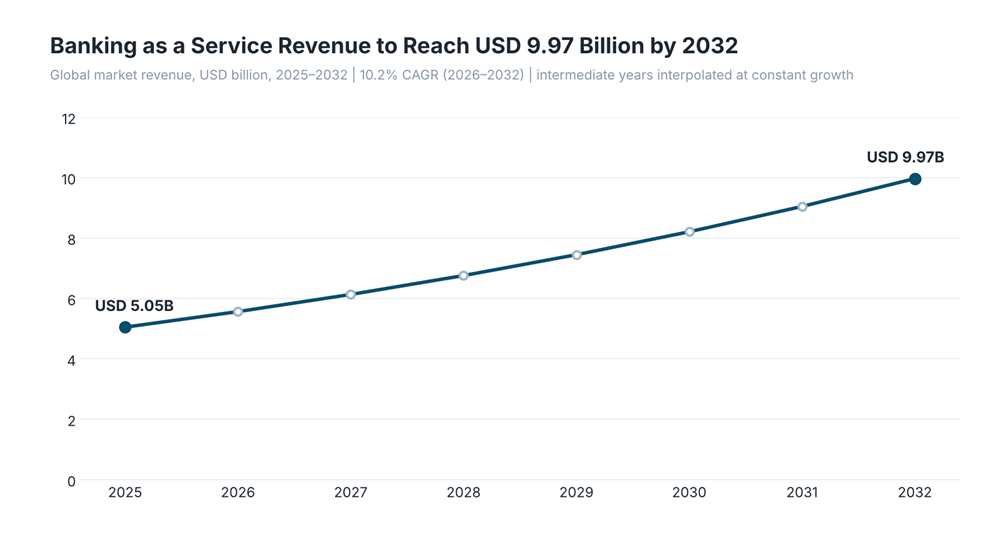
The Global Banking as a Service (BaaS) Market was estimated at USD 5.05 billion in 2025 and is projected to reach USD 9.97 billion by 2032, growing at a CAGR of 10.2% during 2026-2032.


Quick Enquiry
How Are Embedded Finance, Bank–Fintech Partnerships, and Digital Banking Infrastructure Shaping the Global BaaS Market?
The Global Banking as a Service (BaaS) Market was estimated at USD 5.05 billion in 2025 and is projected to reach USD 9.97 billion by 2032, growing at a CAGR of 10.2% during 2026–2032, according to MarketsandStats. The market generates revenue from banking infrastructure supporting digital accounts, card issuing, payment processing, embedded lending, and enterprise financial platforms. In 2025, the industry supported an estimated 108 million billable account-years, 24.5 billion card transactions, and 28.4 billion payment infrastructure transactions, reflecting the scale of banking services delivered through fintech applications and enterprise platforms.
Fintech adoption and embedded financial services are expanding revenue opportunities for licensed banks and infrastructure providers. According to Marqeta's 2025 financial results, the company reported USD 624.9 million in net revenue and USD 382.5 billion in total processing volume, increasing 23% and 31% year on year, respectively. Marqeta's performance highlights the commercial importance of card issuing and transaction processing within the BaaS industry, where payment volumes, customer contracts, and service pricing influence provider revenue.
Why Are Sponsor Banks Earning More From Third-Party Financial Programs?
Licensed banks are expanding Banking as a Service partnerships with fintech companies and enterprise software providers, generating revenue from card issuing, payment processing, account services, and embedded lending. According to The Bancorp's 2025 Annual Report, fintech fee income increased 21% to USD 141.1 million in 2025, including USD 103.5 million from debit and prepaid card services, USD 21 million from payment services, and USD 16.6 million from credit sponsorship.
Enterprise software platforms are becoming an important source of BaaS business, particularly through integrated business accounts, employee expense cards, payroll payments, and embedded financial services. Sponsor banks gain additional fee opportunities and access to commercial customers, although regulatory oversight, compliance expenses, and partnership profitability remain important considerations.
How Are Enterprise Banking Contracts Changing BaaS Pricing and Revenue Quality?
BaaS providers are increasingly adopting subscription and usage-based pricing for enterprise banking infrastructure. According to Griffin's published platform banking pricing, monthly minimum commitments range from GBP 3,500 to GBP 10,000, with onboarding fees starting at GBP 15,000. Transaction charges count toward these commitments, providing a benchmark for contracted platform pricing.
Enterprise contracts and additional banking services remain important revenue opportunities, particularly across account infrastructure, card issuing, and payment processing. However, volume-based discounts negotiated by large fintech customers and competition in standardized payment services continue to pressure provider margins.
How Is the Banking as a Service Market Segmented by Revenue-Generating Services?
Banking Accounts and Ledger Infrastructure: The Largest Revenue Segment
The banking accounts and ledger services segment was valued at USD 1.84 billion in 2025, accounting for approximately 36.4% of global BaaS revenue, and is projected to reach USD 3.60 billion by 2032, growing at a CAGR of 10.1%. Demand is concentrated in digital account administration, transaction reconciliation, and embedded banking platforms serving fintech and enterprise customers.
According to ClearBank's 2025 Annual Report, the company managed 17.1 million real and virtual accounts across 279 live clients, processing 262 million payment scheme transactions in 2025. Account volumes increased 33% and payment transactions rose approximately 57% year on year, highlighting the expanding scale of specialist banking infrastructure. ClearBank's growing account base and payment volumes highlight its expanding role in providing banking infrastructure to fintech companies and financial institutions.
Card Issuing and Processing: Enterprise Programs Expand Transaction Revenue
The card issuing and processing segment was valued at USD 1.12 billion in 2025 and is projected to reach USD 2.23 billion by 2032, expanding at a CAGR of 10.4%. Digital banking cards, corporate expense programs, payroll cards, and embedded financial services account for major commercial applications, with Marqeta and other infrastructure providers serving fintech companies and enterprise platforms.
According to Marqeta's 2025 financial results, the company reported USD 382.5 billion in total processing volume, increasing 31% year on year, while net revenue rose 23% to USD 624.9 million. Corporate expense management, digital banking, and embedded card programs remain important areas of competition, with transaction volumes and enterprise client relationships influencing provider revenues.
Payment Infrastructure: High Activity Creates Opportunities but Compresses Unit Economics
The payment infrastructure segment was valued at USD 617.5 million in 2025 and is projected to reach USD 1.26 billion by 2032, expanding at a CAGR of 10.7%. Account-to-account transfers, business disbursements, and payment connectivity services represent key revenue categories, supported by growing adoption of embedded payments among fintech companies and enterprise platforms.
India and Brazil are important markets for digital payment infrastructure, supported by widespread adoption of UPI and Pix, respectively. However, low transaction fees and competitive pricing remain challenges for BaaS providers. Enterprise payment contracts, banking partnerships, and integrated account services are increasingly important areas of commercial competition.
Embedded Lending: Revenue Opportunities Extend Beyond Payment Processing
The embedded lending infrastructure segment was valued at USD 398 million in 2025 and is projected to reach USD 812 million by 2032, expanding at a CAGR of 10.7%. Loan origination services, credit program administration, and loan servicing represent key revenue categories, particularly among fintech lenders and enterprise financial platforms.
The Bancorp reported USD 16.6 million in credit sponsorship fee income in 2025, highlighting the participation of regulated banks in embedded lending programs. Credit regulation, lending activity, and third-party risk management remain important considerations for infrastructure providers, while established enterprise partnerships support opportunities in loan administration and servicing.
Enterprise Banking Platforms and APIs: Contracted Services Support Revenue Stability
The enterprise platform, API, and compliance infrastructure segment accounted for an estimated USD 1.08 billion in 2025 and is forecast to reach USD 2.06 billion by 2032, expanding at an estimated CAGR of 9.6%.
Revenue comes from eligible enterprise banking platform access, integrations, and contracted infrastructure services that are not already included in account, payment, card, or lending fees.
The segment benefits from financial software companies and fintech platforms seeking established banking infrastructure instead of developing equivalent capabilities internally. However, recurring contracts differ significantly in size and structure. Smaller integrations may involve relatively modest commitments, while complex enterprise programs can require customized banking relationships and substantially greater investment.
Maintaining established customers and expanding service usage will be important sources of revenue for platform providers. At the same time, integration expenditure, regulatory requirements, and competition from banks developing their own API capabilities may influence operating margins.
Which Countries Are Leading the Banking as a Service Market?
United States: Established Sponsor-Bank Infrastructure Supports Market Leadership
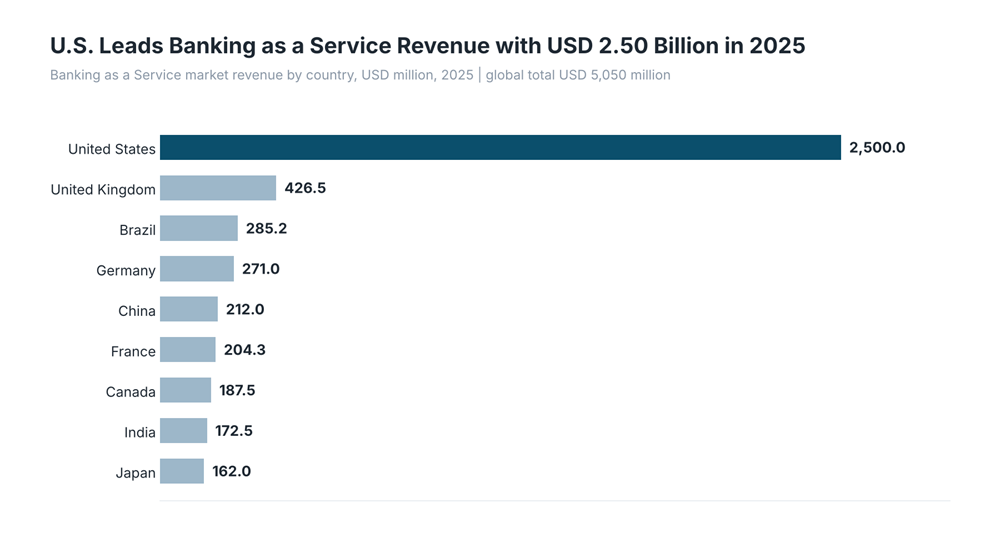
The United States Banking as a Service Market was estimated at USD 2.50 billion in 2025 and is projected to reach USD 4.65 billion by 2032, expanding at an estimated CAGR of 9.3%.
The United States leads the Banking as a Service (BaaS) Market, supported by established sponsor banks, fintech card programs, and enterprise banking partnerships. Major participants include The Bancorp, Marqeta, and Green Dot. The Bancorp reported USD 141.1 million in fintech fee income in 2025, increasing 21% year on year, while Marqeta processed USD 382.5 billion in card transactions, highlighting the scale of U.S. banking infrastructure services.
Regulatory oversight remains a major concern for sponsor banks. In July 2024, the Federal Reserve, FDIC, and OCC issued joint guidance addressing customer account records, deposit reconciliation, and third-party risk management in bank–fintech partnerships. Compliance obligations and partner oversight remain significant considerations for banks expanding their BaaS operations.
United Kingdom: Embedded Banking and Enterprise Payment Services Sustain Growth
The United Kingdom BaaS Market was valued at USD 426.5 million in 2025 and is projected to reach USD 896.7 million by 2032, expanding at a CAGR of 11.2%. Established fintech companies and regulated banking infrastructure providers, including ClearBank and Griffin, support demand for digital accounts, payment processing, and enterprise banking services.
According to UK Finance, the country recorded 49.7 billion payment transactions in 2025, including 6.2 billion Faster Payments and other remote banking payments, up 10% year on year. ClearBank and Griffin compete in this expanding financial infrastructure market, with enterprise banking contracts, payment processing fees, and regulatory compliance costs shaping their commercial performance.
Brazil: Pix Adoption Expands Financial Activity but Limits Direct Fee Monetization
The Brazil BaaS Market was valued at USD 285.2 million in 2025 and is projected to reach USD 692 million by 2032, expanding at a CAGR of 13.5%. Digital banking expansion and widespread Pix adoption support opportunities in embedded payments, account infrastructure, card issuing, and enterprise financial services.
According to the Central Bank of Brazil's official Pix statistics, Pix has become a major payment channel for consumers and businesses. Dock is among Brazil's established banking and payment infrastructure providers, serving financial institutions and enterprises through integrated financial services. Low Pix transaction fees remain a pricing challenge, with account services, card programs, and embedded credit representing additional revenue opportunities for BaaS providers.
Germany: Regulated Financial Infrastructure Supports Enterprise Adoption
The Germany BaaS Market was valued at USD 271 million in 2025 and is projected to reach USD 495.4 million by 2032, expanding at a CAGR of 9.0%. Embedded business banking, digital account services, and enterprise payment infrastructure remain important areas of investment, supported by demand from fintech companies and financial software providers.
The European Union's Instant Payments Regulation is influencing Germany's banking infrastructure market, with requirements for instant euro transfers and verification of payees increasing compliance and technology spending among payment service providers. Established banking relationships, regulatory requirements, and lengthy enterprise onboarding processes remain important considerations for BaaS providers competing in Germany.
India: Strong Digital Payment Adoption Creates Opportunities for Enterprise Banking Services
The India BaaS Market was estimated at USD 172.5 million in 2025 and is projected to reach USD 487.5 million by 2032, expanding at an estimated CAGR of 16.0%. India is emerging as a fast-growing BaaS market, with increasing demand from fintech companies, SME banking platforms, and enterprise software providers. Embedded payments, business accounts, and digital lending services are attracting commercial interest, supported by India's expanding digital financial ecosystem.
According to the National Payments Corporation of India, UPI processed more than 21 billion transactions in December 2025. This scale demonstrates widespread digital payment adoption, although only a portion of these transactions can generate identifiable BaaS service revenue. Source: NPCI - UPI Product Statistics
India's commercial opportunities extend beyond payment processing. Enterprise banking APIs, business accounts, card programs, and lending infrastructure may provide additional monetization opportunities for technology providers and their regulated banking partners.
M2P Fintech and Decentro are among India's financial infrastructure providers, offering services across card issuing, payment APIs, and embedded banking. Their participation strengthens competition in digital financial services, particularly among fintech companies and enterprise platforms.
China: Large Financial Technology Ecosystem Creates Selective Infrastructure Opportunities
The China BaaS Market was valued at USD 212 million in 2025 and is projected to reach USD 413.1 million by 2032, expanding at a CAGR of 10.0%. Enterprise payment services, banking integrations, and financial infrastructure partnerships represent key opportunities, particularly among fintech companies and business platforms.
China's digital financial services market remains dominated by established banks and major technology platforms, limiting opportunities for independent BaaS providers. Competition is concentrated in enterprise financial services and specialized banking infrastructure, while established institutions' preference for in-house systems remains a significant barrier to market expansion.
France: European Banking Integration Supports Platform Expansion
The France BaaS Market was valued at USD 204.3 million in 2025 and is projected to reach USD 398 million by 2032, expanding at a CAGR of 10.0%. Demand is concentrated in regulated payment infrastructure, digital account services, and embedded banking solutions for fintech companies and enterprise platforms.
Treezor and ClearBank are important participants in France's banking infrastructure ecosystem. ClearBank expanded its European operations and customer relationships during 2025, including its presence in France. Cross-border banking services and enterprise financial integrations remain important commercial opportunities, with European regulatory requirements influencing provider competition.
Canada and Japan: Established Banking Relationships Influence Market Development
The Canada BaaS Market was valued at USD 187.5 million in 2025 and is projected to reach USD 342.8 million by 2032, expanding at a CAGR of 9.0%. Card issuing, fintech partnerships, and enterprise payment services represent key opportunities. Canada's concentrated banking sector and established financial institutions influence competition and access to sponsor-bank partnerships.
The Japan BaaS Market was valued at USD 162 million in 2025 and is projected to reach USD 277.6 million by 2032, growing at a CAGR of 8.0%. Enterprise banking services, embedded payments, and financial technology partnerships remain important areas of activity. Established banking relationships and regulatory requirements continue to shape competition among financial infrastructure providers.
How Are Leading Companies Positioning Themselves in the Banking as a Service Market?
Marqeta is a major participant in the BaaS market's card issuing and processing segment, reporting approximately USD 383 billion in total processing volume and a 70% gross margin in 2025. Its infrastructure supports digital banking, corporate expense management, and embedded card programs. Marqeta's 2025 SEC Filing highlights its processing scale and established enterprise relationships.
The Bancorp and ClearBank hold important positions in regulated banking infrastructure. The Bancorp generated USD 141.1 million in fintech fee income in 2025, supported by card sponsorship, payment services, and credit programs. ClearBank reported 17.1 million real and virtual accounts, 279 live clients, and 262 million payment transactions, reflecting its established presence in account and payment infrastructure. ClearBank's 2025 Annual Report also highlights its expanding embedded banking relationships.
Green Dot, Stripe, Griffin, Solaris, Banking Circle, and Treezor compete across enterprise banking and financial infrastructure services. Green Dot participates through B2B banking programs, Stripe through embedded financial services and card issuing, and Griffin through regulated platform banking. Solaris and Treezor serve European embedded banking customers, while Banking Circle specializes in banking and payment infrastructure for financial institutions.
Enterprise contracts, processing fees, regulatory compliance costs, and banking partnerships remain important areas of competition. Providers with diversified financial services and established institutional relationships compete alongside specialist platforms focused on individual banking functions.
Why Are Regulatory Oversight and Revenue Concentration Becoming Major Commercial Risks?
Regulatory compliance and customer concentration remain major challenges in the Banking as a Service (BaaS) market. In July 2024, the Federal Reserve, FDIC, and OCC highlighted risks involving customer deposit records, account reconciliation, and third-party oversight in bank–fintech partnerships. The statement reinforced existing supervisory expectations, placing greater attention on sponsor-bank accountability and fintech risk management.
Compliance expenditure, lengthy onboarding processes, and dependence on large fintech clients continue to pressure provider profitability. Smaller BaaS platforms face higher relative operating costs, while large enterprise customers can negotiate lower processing fees. Client concentration, sponsor-bank relationships, and recurring contract revenue remain important considerations for infrastructure providers.
Analyst Commentary
“Sponsor-bank dependency and fintech program profitability are becoming critical issues in the Banking as a Service (BaaS) market. The Bancorp generates fee income across card sponsorship, payments, and credit programs, while Marqeta has established a significant position in card issuing and processing. Banks and infrastructure providers are paying closer attention to client profitability, revenue concentration, and the accuracy of customer account records. Fintech programs with high transaction volumes but weak margins or costly compliance requirements are becoming less attractive, particularly for banks managing multiple third-party relationships.”