

Automotive Multilayer Ceramic Capacitor Market (2026-2032)
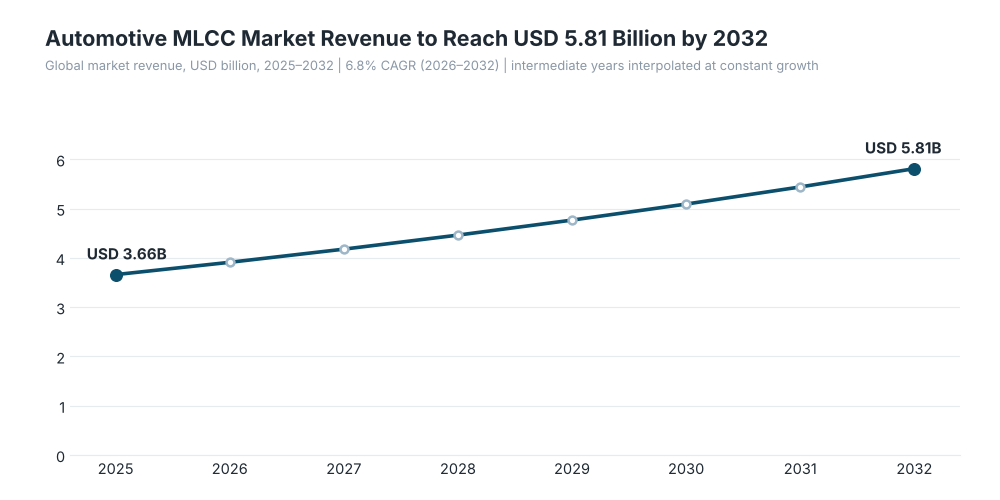
The global Automotive Multilayer Ceramic Capacitor (MLCC) Market was valued at USD 3.66 billion in 2025 and is projected to reach USD 5.81 billion by 2032, expanding at a CAGR of approximately 6.8% during 2026-2032.



Quick Enquiry
How Large Is the Global Automotive Multilayer Ceramic Capacitor Market?
The global Automotive Multilayer Ceramic Capacitor (MLCC) Market was valued at USD 3.66 billion in 2025 and is projected to reach USD 5.81 billion by 2032, expanding at a CAGR of approximately 6.8% during 2026-2032, according to MarketsandStats. Market growth is driven by increasing electric vehicle production, advanced driver assistance systems (ADAS), connected vehicle technologies, and the growing use of electronic control units. Automotive manufacturers are prioritizing compact, high-capacitance, and reliable capacitors capable of operating under demanding temperature, voltage, and mechanical conditions.
Class II ceramic capacitors dominated the market with USD 3.04 billion in revenue in 2025, representing 83.2% of the global market. By construction, conventional chip MLCCs contributed approximately USD 2.55 billion, while soft-termination capacitors accounted for USD 1.00 billion. Powertrain and electrification electronics represented a major application segment at USD 1.03 billion, followed by ADAS and electronic safety systems at USD 997 million. Increasing adoption of high-capacitance components, flexible-termination technologies, and capacitors designed for automotive computing platforms is creating opportunities for manufacturers specializing in advanced automotive electronics.
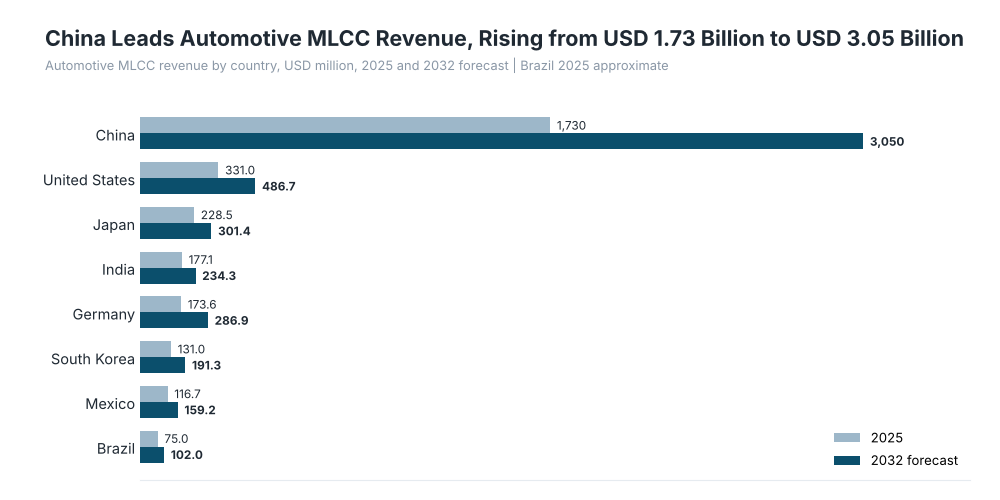
Asia-Pacific accounted for the largest regional share at 66.7%, generating approximately USD 2.44 billion in 2025. China led the national markets with USD 1.73 billion, followed by the United States at USD 331 million and Japan at USD 228.5 million. China, Japan, and South Korea account for substantial automotive electronics production, with local MLCC manufacturers supplying major vehicle and component makers. Growing investments in vehicle electrification and electronic safety technologies continue to influence regional demand.
Automakers are increasingly specifying MLCCs that can withstand high temperatures, vibration, and mechanical stress. AEC-Q200 qualification requirements are widely used to assess the reliability of automotive-grade passive components under thermal, vibration, and other operating stresses. Demand for soft-termination MLCCs is also increasing as manufacturers seek components that can withstand mechanical stress in vehicle electronics. Battery management, powertrain, and braking systems require capacitors with consistent performance under demanding operating conditions.
Leading manufacturers include Murata Manufacturing, KEMET (Yageo Group), TDK Corporation, and Samsung Electro-Mechanics. Murata's GCM series serves automotive powertrain, airbag, and anti-lock braking applications. KEMET offers flexible-termination and high-voltage automotive capacitors, including its HV FT-CAP portfolio. TDK and Samsung Electro-Mechanics compete through high-capacitance and high-temperature MLCC solutions, including products designed for operating temperatures up to 150°C. Murata, TDK, Samsung Electro-Mechanics, and KEMET are expanding automotive MLCC offerings to meet demand for higher capacitance, temperature resistance, and consistent supply.
Rising capacitor usage in electric vehicles, ADAS, and connected car systems is expected to drive MLCC sales through 2032. High-capacitance MLCCs, soft-termination products, and automotive-grade capacitors for advanced computing and safety systems are expected to remain important growth areas. Asia-Pacific is likely to maintain its leading position, while manufacturers with established automotive qualifications, broad product portfolios, and reliable supply capabilities are well-positioned to capture future demand.
What Is Driving Growth in the Automotive MLCC Market?
Electrified Powertrains Increase Demand for High-Reliability Capacitors
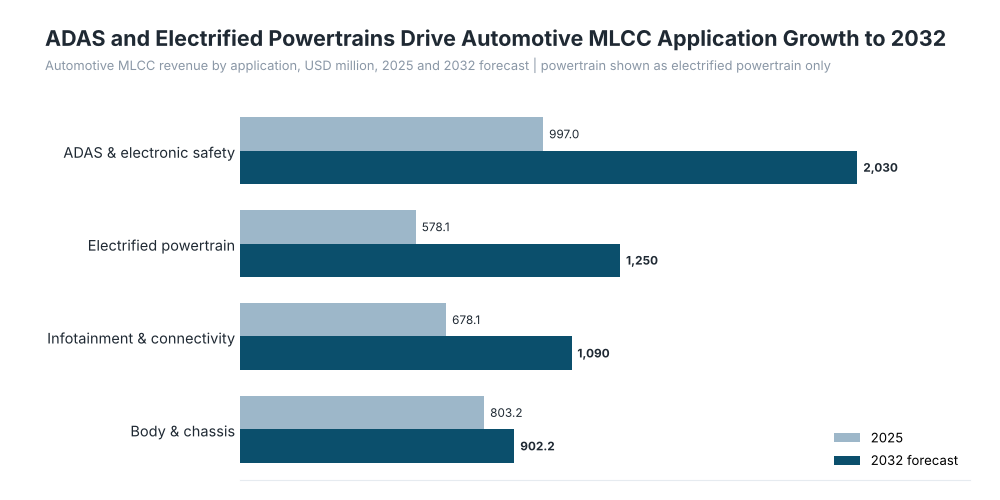
The electrified powertrain segment generated approximately USD 578.1 million in 2025 and is projected to reach USD 1.25 billion by 2032. Battery management systems, onboard chargers, inverters, and DC-DC converters are major applications for automotive MLCCs. Conventional powertrain electronics contributed another USD 450.3 million, bringing combined powertrain and electrification revenue to approximately USD 1.03 billion in 2025.
According to the International Energy Agency, global electric car sales exceeded 20 million in 2025, increasing 20% year over year, with electric vehicles accounting for one-quarter of new car sales. China alone produced nearly 75% of the world's electric cars, making it a major market for automotive electronic components. Higher EV production is increasing the potential demand for qualified MLCCs used in battery control, charging, and power conversion circuits.
The introduction of 800 V and higher-voltage electric vehicle architectures is also creating opportunities for high-voltage MLCCs. Automakers pursuing faster charging and improved power efficiency require capacitors suited to different voltage and temperature conditions. Manufacturers with established automotive qualifications and broad voltage-rating portfolios can compete for component supply contracts across multiple electric vehicle platforms.
ADAS and Electronic Safety Create New Revenue Opportunities
ADAS and electronic safety accounted for approximately USD 997 million in 2025 and are projected to reach USD 2.03 billion by 2032. Increasing adoption of radar, cameras, automated braking, collision avoidance, and automotive processors is raising demand for compact, high-capacitance MLCCs in safety electronics.
For example, in September 2025, BMW and Qualcomm introduced the Snapdragon Ride Pilot automated driving system in the BMW iX3. The platform supports configurations ranging from single-camera safety systems to multi-camera and multi-radar driver assistance. Such integrated computing platforms create additional opportunities for automotive-qualified capacitors used in processor power supply and electronic control circuits.
Capacitor manufacturers are responding with products designed for advanced automotive computing. In April 2026, Murata announced mass production of seven AEC-Q200-qualified automotive MLCCs, including five high-capacitance GCM-series components targeting ADAS and autonomous driving processors. ADAS is projected to become the largest individual automotive MLCC application by 2032, offering opportunities for manufacturers supplying high-capacitance, space-efficient components.
Connected Vehicles Expand Infotainment and Communication Demand
The infotainment and connectivity segment generated approximately USD 678.1 million in 2025, representing 18.5% of global automotive MLCC revenue, and is projected to reach USD 1.09 billion by 2032. Digital instrument clusters, high-resolution displays, telematics, navigation, and centralized vehicle computing are major sources of capacitor demand.
For example, Qualcomm announced in October 2024 that Mercedes-Benz and Li Auto had selected its Snapdragon Elite automotive platforms for future vehicles. These platforms are designed to deliver more advanced digital cockpit and computing functions, increasing the importance of compact power management components in vehicle electronics.
Qualcomm also reported USD 1.1 billion in automotive revenue in the first quarter of fiscal 2026, up 15% year over year, alongside a USD 45 billion automotive design-win pipeline. Although these figures represent Qualcomm's broader automotive business rather than MLCC sales, they indicate the scale of investment in digital cockpit, connectivity, and driver assistance platforms. Automotive MLCC manufacturers can benefit from these programs by supplying capacitors for processors, displays, communication modules, and associated power management circuits.
Which Types of Automotive MLCCs Lead the Market?
Class II Ceramic Capacitors Dominate with 83.2% Market Share
Class II ceramic capacitors generated approximately USD 3.04 billion in 2025 and are projected to reach USD 4.89 billion by 2032, accounting for 83.2% of market revenue in 2025. Their widespread use in automotive power supplies, electronic control units, ADAS processors, and infotainment systems accounts for their leading position. X5R, X7R, and X8R dielectrics are commonly selected for applications requiring higher capacitance in compact packages.
For example, Samsung Electro-Mechanics introduced two automotive X7R MLCCs in May 2024, rated at 1,000 V and 2,000 V. The company reported that the new products offered twice the capacitance of its previous comparable components at the same size and voltage rating. Such improvements allow automotive electronics suppliers to accommodate higher electrical requirements without substantially increasing circuit-board space.
Class I ceramic capacitors generated approximately USD 614 million in 2025 and are projected to reach USD 924.5 million by 2032. These products serve precision timing, signal processing, and frequency-sensitive circuits. TDK's automotive C0G MLCCs, for instance, offer capacitance drift of approximately 0.3% across temperatures from −55°C to +125°C, making them suitable for precision charging and resonant circuits.
Low-Voltage MLCCs Lead, While Higher-Voltage Products Gain Momentum
MLCCs rated below 25 V generated approximately USD 1.49 billion in 2025, representing 40.7% of market revenue, and are projected to reach USD 2.19 billion by 2032. Automotive processors, infotainment modules, electronic control units, and communication circuits account for much of this demand. The 25 V to below 50 V category contributed USD 836.1 million, while the 50 V to below 100 V segment generated USD 644.5 million.
Higher-voltage products are gaining ground in automotive power electronics. The 100 V to below 500 V segment is projected to increase from USD 550.3 million in 2025 to USD 1.03 billion by 2032, while the 500 V and above category is expected to grow from USD 136.9 million to USD 276.1 million.
In April 2026, Samsung Electro-Mechanics introduced automotive MLCCs rated from 1,000 V to 1,500 V, with capacitance values ranging from 1.2 nF to 33 nF. The products target high-voltage powertrains, including onboard charging and inverter applications. The launch highlights a commercial opportunity for manufacturers capable of supplying qualified high-voltage components as automotive electrical architectures become more demanding.
High-Capacitance Products Offer Strong Growth Opportunities
The 1 µF to below 10 µF segment led the market with approximately USD 1.19 billion in 2025, accounting for 32.5% of revenue, and is projected to reach USD 1.99 billion by 2032. These capacitors are widely used in power supply filtering, electronic control modules, and automotive computing systems.
Capacitors rated 100 nF to below 1 µF contributed USD 1.13 billion in 2025, while products below 100 nF accounted for USD 776.4 million. The 10 µF and above segment is projected to grow from USD 564.4 million in 2025 to USD 1.12 billion by 2032, reflecting demand for higher capacitance within limited circuit-board space.
For example, KYOCERA AVX introduced its high-capacitance KAM automotive MLCC series, offering capacitance values from 100 nF to 22 µF and voltage ratings from 2.5 V to 16 V. The AEC-Q200-compliant series targets automotive processors, camera and radar control units, telematics, and digital instrument clusters. These products allow electronics manufacturers to accommodate demanding power supply requirements while reducing component space.
Soft-Termination MLCCs Gain Importance in Automotive Electronics
Conventional chip MLCCs remained the largest construction category, generating USD 2.55 billion in 2025 and representing approximately 69.7% of market revenue. Revenue is projected to reach USD 3.66 billion by 2032, reflecting their extensive use across established automotive electronic applications.
Soft-termination and flexible-termination MLCCs accounted for approximately USD 1.00 billion in 2025 and are projected to reach USD 1.97 billion by 2032. Automotive electronics manufacturers increasingly specify these components for assemblies exposed to circuit-board bending, thermal cycling, and mechanical stress.
For example, KYOCERA AVX's FLEXITERM KAF automotive MLCC series offers resistance to board flexure of up to 5 mm without internal cracking, compared with the automotive industry's standard 2 mm minimum flexure requirement cited by the manufacturer. The series is AEC-Q200-qualified and includes products rated up to 200 V. This additional mechanical protection is commercially relevant for automotive electronics suppliers seeking to reduce capacitor cracking and associated warranty risks.
Which Applications and End Users Generate the Largest Revenue?
Powertrain and ADAS Account for Major Automotive MLCC Demand
Powertrain and electrification electronics generated approximately USD 1.03 billion in 2025, making them the largest automotive MLCC application grouping. ADAS and electronic safety followed at USD 997 million, while body and chassis electronics contributed USD 803.2 million.
Demand from body and chassis electronics covers electronic steering, braking, lighting, climate control, and vehicle management systems. For example, Bosch's Vehicle Motion division supplies electronic braking, steering, and vehicle stability control systems, including ABS and ESP technologies. These applications require automotive-qualified capacitors for electronic control and power management circuits. Body and chassis MLCC revenue is projected to reach USD 902.2 million by 2032.
ADAS and electronic safety revenue is projected to reach USD 2.03 billion by 2032, compared with USD 1.09 billion for infotainment and connectivity. Valeo reported approximately EUR 3.03 billion in ADAS sales during 2025, illustrating the commercial scale of automotive safety electronics. Although this represents ADAS system revenue rather than capacitor sales, it identifies a substantial customer market for MLCC suppliers serving radar, camera, and electronic control applications.
Tier 1 Automotive Electronics Suppliers Lead Component Procurement
Tier 1 automotive electronics suppliers accounted for approximately USD 2.54 billion in 2025, representing 69.5% of automotive MLCC market revenue. Companies such as Bosch, DENSO, and Valeo manufacture electronic control units, braking systems, powertrain electronics, and ADAS modules, making them important customers for automotive capacitor manufacturers.
For example, DENSO reported a 3.9% increase in Mobility Electronics revenue and a 9.1% increase in Electrification Systems revenue for the financial year ended March 2025. Growth in safety-related electronic control units and inverters illustrates the expanding automotive electronics applications served by major Tier 1 suppliers.
Automotive OEMs with in-house electronics operations generated approximately USD 625.7 million in MLCC demand in 2025 and are projected to reach USD 1.28 billion by 2032. Independent electronics manufacturers contributed another USD 450.5 million. As automakers develop more electronics internally, capacitor suppliers have opportunities to work directly with vehicle manufacturers alongside established Tier 1 customers.
What Are the Leading Technology Trends in the Automotive MLCC Market?
High-Capacitance Miniaturization Gains Momentum in Automotive Electronics
Automotive MLCC manufacturers are increasing capacitance within smaller packages to meet the requirements of ADAS processors, vehicle control units, and advanced power electronics. Smaller capacitors allow automotive electronics suppliers to accommodate more components within limited circuit-board space.
In April 2026, Murata Manufacturing began mass production of seven AEC-Q200-qualified automotive MLCCs, including five designed for ADAS and autonomous driving circuits. The company introduced a 100 µF capacitor in a 3.2 × 1.6 mm package, reducing mounting area by approximately 36% compared with its previous larger design. The smaller footprint provides automotive electronics manufacturers with additional space for processors and other components.
AI-Based ADAS Drives Demand for Compact High-Capacitance MLCCs
Advanced driving processors require stable power supplies, creating demand for capacitors with higher capacitance and smaller dimensions. Camera processing, radar systems, and integrated safety electronics are among the applications influencing new MLCC development.
In October 2026, Samsung Electro-Mechanics announced mass production of a 10 µF, 2.5 V automotive MLCC measuring 1.0 × 0.5 mm for ADAS applications. The company also confirmed mass production of 22 µF MLCCs in 1.6 × 0.8 mm packages. Both product developments target higher capacitance requirements in compact automotive electronic assemblies. Manufacturers offering such components can pursue supply opportunities in next-generation automotive computing platforms.
Flexible-Termination MLCCs Address Mechanical Reliability Requirements
Automotive electronics suppliers are increasingly selecting capacitors designed to withstand circuit-board stress while maintaining electrical performance. Flexible-termination products are particularly relevant to powertrain electronics, 48 V systems, and vehicle control modules exposed to demanding operating conditions.
In September 2026, TDK Corporation announced a 100 V, 10 µF X7R soft-termination MLCC in a 3.2 × 2.5 mm package, qualified to AEC-Q200 requirements. The product offers twice the capacitance of TDK's previous comparable capacitors of the same size while maintaining low terminal resistance. Its higher capacitance can also reduce the number of components required in certain circuit designs, offering potential savings in board space and assembly costs.
Which Countries Lead the Global Automotive MLCC Market?
China - Largest National Market at USD 1.73 Billion
China's automotive MLCC market was estimated at USD 1.73 billion in 2025 and is projected to reach USD 3.05 billion by 2032. The country's large electric vehicle manufacturing industry and extensive automotive electronics supply chain support demand for capacitors used in battery management, power conversion, ADAS and connected vehicle systems.
According to the IEA, China accounted for nearly 75% of global electric car production in 2025, equivalent to approximately 16 million vehicles. BYD, Geely, SAIC Motor and Chery contribute to domestic requirements for advanced electronic components, while local suppliers such as Guangdong Fenghua Advanced Technology participate in capacitor manufacturing.
China's growing electronics localization and competitive vehicle manufacturing environment create opportunities for automotive MLCC suppliers capable of meeting customer-specific qualification and pricing requirements. High-capacitance Class II products and capacitors used in electrified powertrains remain important commercial categories.
United States - Advanced Vehicle Electronics Support Market Demand
The United States automotive MLCC market generated approximately USD 331 million in 2025 and is projected to reach USD 486.7 million by 2032. Demand is concentrated in electronic safety, electrified powertrains, digital cockpits and advanced vehicle computing applications.
General Motors, Ford and Tesla represent important automotive manufacturers purchasing sophisticated electronic systems, while suppliers such as Aptiv and Visteon participate in vehicle electronics architecture, connected technologies and digital cockpit development. These applications create purchasing opportunities for high-reliability capacitors supplied through established electronic component and automotive module manufacturers.
The U.S. market is particularly relevant to advanced automotive electronics, where long-term component qualification and reliable supply are important procurement considerations. Demand for high-capacitance, compact and automotive-qualified MLCCs is expected to remain closely associated with investment in sophisticated vehicle control and safety systems.
Japan - High-Capacitance Product Innovation Supports Market Development
Japan's automotive MLCC market was estimated at USD 228.5 million in 2025 and is projected to reach USD 301.4 million by 2032. The country combines established automotive manufacturing with advanced capacitor technology, high-reliability component production and substantial demand from hybrid vehicle electronics.
In May 2026, Taiyo Yuden commercialized a 220 µF automotive-grade MLCC in a 3.2 × 2.5 mm package, offering more than twice the capacitance of its comparable conventional product. Mass production began at the company's Tamamura plant in Gunma Prefecture. The component is intended for automotive control, ADAS, ABS and instrument-cluster applications.
The development highlights Japan's strengths in compact, high-capacitance components and automotive qualification. Domestic demand from Toyota, Honda and other vehicle manufacturers also supports opportunities in hybrid powertrains, safety electronics and advanced vehicle control systems.
Germany - Automotive Electronics and Semiconductor Capabilities Support Demand
Germany generated approximately USD 173.6 million in automotive MLCC revenue in 2025 and is projected to reach USD 286.9 million by 2032. Demand is associated with premium automotive electronics, electrified powertrains, electronic safety and advanced vehicle control systems.
Volkswagen Group, BMW and Mercedes-Benz are important participants in the country's automotive electronics market. Germany also maintains an established semiconductor manufacturing and automotive technology industry, supporting domestic capabilities in advanced electronic components.
Bosch's Dresden semiconductor facility manufactures automotive integrated circuits and power semiconductor products used in vehicle electronic systems. Its domestic semiconductor operations illustrate Germany's broader automotive electronics capabilities and the requirements for qualified passive components used alongside advanced electronic devices.
High-reliability MLCCs, flexible-termination products and capacitors suitable for electrified powertrain applications represent relevant opportunities for suppliers serving German automotive customers.
India - Automotive Electronics Localization Creates New Opportunities
India's automotive MLCC market was estimated at USD 177.1 million in 2025 and is projected to reach USD 234.3 million by 2032. Growing domestic production of electronic control units, electric powertrain components, battery management systems and vehicle infotainment products is creating opportunities for automotive-grade capacitor suppliers.
According to the Ministry of Heavy Industries, India's Production Linked Incentive Scheme for automobiles and auto components had 82 approved applicants as of November 2025. The scheme supports manufacturing investment in advanced automotive technology products, including electric vehicle components and related systems.
Tata Motors, Mahindra & Mahindra, Maruti Suzuki and established Indian automotive suppliers contribute to demand for local electronics manufacturing. Increasing investment in domestic control units, chargers and electric powertrain components creates opportunities for qualified MLCC distribution and component integration, although advanced MLCC manufacturing remains less established domestically than in major East Asian supplier markets.
South Korea - Electrified Vehicle Platforms Support Advanced Capacitor Demand
South Korea's automotive MLCC market was estimated at USD 131 million in 2025 and is projected to reach USD 191.3 million by 2032. Domestic demand is supported by electric vehicle electronics, ADAS, vehicle communication systems and advanced automotive control applications.
Hyundai Motor Group and Kia are important customers within the country's automotive manufacturing sector, while Hyundai Mobis develops electronic systems for vehicle safety, electrification and advanced driver assistance. These domestic supplier relationships support opportunities for capacitors used in powertrain control, electronic safety and connected vehicle applications.
South Korea's established electronic component manufacturing capabilities also contribute to product development and export opportunities. Growing demand for compact, high-capacitance components in electrified and technologically advanced vehicles remains particularly relevant to the country's automotive electronics industry.
Mexico - Automotive Electrical Parts Manufacturing Supports MLCC Demand
Mexico's automotive MLCC market was estimated at USD 116.7 million in 2025 and is projected to reach USD 159.2 million by 2032. Demand is closely associated with electronic module assembly, vehicle electrical components and automotive manufacturing serving North American customers.
According to Mexico's National Auto Parts Industry Association, electrical parts represented 19.3% of national auto parts production in 2025, equivalent to approximately USD 22.97 billion. Mexico also retained its position as the largest foreign supplier of automotive parts to the United States.
Automotive manufacturing concentrations in Coahuila, Guanajuato, Nuevo León, Chihuahua and Querétaro provide opportunities for MLCC suppliers serving electronic component distributors, circuit-board assemblers and automotive system manufacturers. Long-term supply contracts, component qualification and dependable delivery are important commercial factors within Mexico's export-oriented automotive electronics industry.
Brazil - Hybrid-Flex Vehicle Development Creates Distinct Electronics Opportunities
Brazil's automotive MLCC market accounted for approximately USD 75 million in 2025 and is projected to reach USD 102 million by 2032. Demand is concentrated in engine control systems, body electronics, vehicle infotainment and increasingly sophisticated hybrid powertrain applications.
Brazil's automotive industry is developing electrification technologies compatible with its established ethanol-based fuel market. Stellantis introduced Bio-Hybrid technology through the Fiat Pulse and Fastback models, combining electrification with flex-fuel powertrains. The company also established development capabilities at its Betim automotive complex.
Hybrid-flex vehicles combine conventional engine electronics with additional electric power management and control systems, creating opportunities for qualified capacitors across multiple applications. Brazil's established automotive component industry remains important for suppliers serving regional electronic module production and powertrain development.
Which Companies Lead Competition in the Automotive MLCC Market?
Murata Manufacturing, Samsung Electro-Mechanics, TDK Corporation, Taiyo Yuden, and Yageo Group (including KEMET) are among the leading automotive MLCC manufacturers, alongside Kyocera, Walsin Technology, and Vishay Intertechnology. Japanese suppliers maintain established positions in automotive capacitor development, while South Korean and Taiwanese manufacturers compete across high-capacitance, high-voltage, and conventional automotive-grade products.
Competition is increasingly influenced by customer qualification and the ability to secure long-term automotive electronics contracts. Manufacturers supplying specialized capacitors for ADAS, electric powertrains, and safety applications have opportunities to strengthen their positions with Tier 1 customers. Established automotive qualifications and consistent product availability can also reduce customers' willingness to change suppliers, particularly in applications requiring extensive reliability testing.
Tier 1 automotive electronics suppliers represented approximately USD 2.54 billion, or 69.5% of automotive MLCC demand in 2025. These customers account for a substantial share of component procurement and influence supplier selection across multiple vehicle programs. Chinese capacitor manufacturers are expanding their competitive presence, particularly in conventional Class II products, increasing pricing pressure on established international suppliers. Manufacturers with stronger high-capacitance and high-reliability portfolios may be better positioned to protect margins as competition intensifies.
Analyst Perspective: Automotive MLCC Suppliers Face a Critical Pricing and Capacity Decision
The automotive MLCC market is entering a period where capacity expansion in standard capacitors could become less profitable than investment in specialized automotive products. China's growing domestic component manufacturing capabilities are likely to strengthen buyers' negotiating positions, particularly for widely available Class II capacitors. Japanese, South Korean, and Taiwanese manufacturers consequently face a strategic choice between defending high-volume contracts through lower prices and directing investment toward products where automotive qualification and performance requirements limit supplier substitution.
A second concern is that higher capacitance does not necessarily translate into higher component revenue. As manufacturers introduce 22 µF, 100 µF, and higher-capacitance MLCCs in smaller packages, automotive electronics suppliers may replace several conventional capacitors with fewer advanced components. This could increase revenue per component while reducing the total number purchased. The commercial advantage will depend on whether manufacturers can secure sufficient pricing premiums to offset potential reductions in component quantities.
We expect the strongest suppliers to prioritize automotive design approvals before committing to major capacity additions. A high-capacitance product qualified for a widely adopted ADAS or powertrain platform can generate more predictable orders than additional production capacity aimed at an increasingly competitive standard capacitor market. The important distinction through 2032 will be between manufacturers gaining profitable content in vehicle electronics and those expanding shipments without improving their product mix or margins.