
AI Server Multilayer Ceramic Capacitor ( MLCC ) Market (2026-2032)
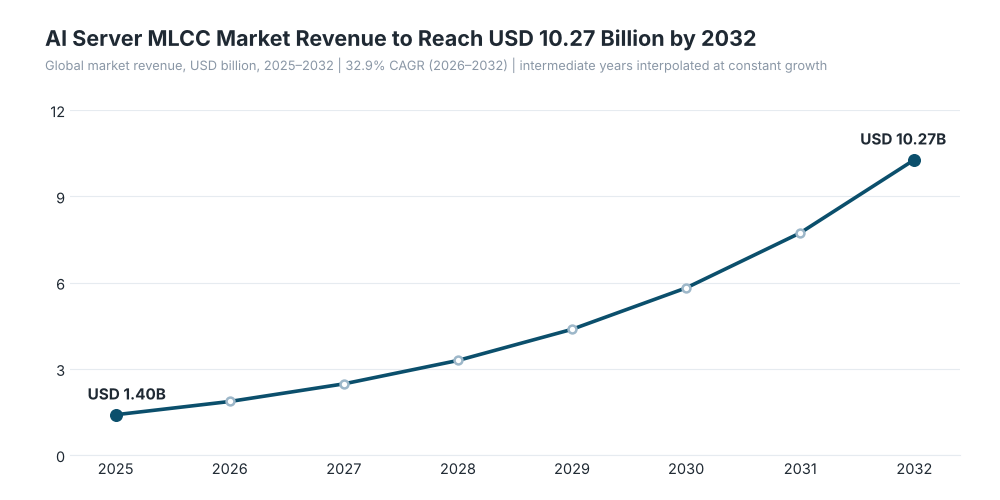
The global AI Server Multilayer Ceramic Capacitor (MLCC) Market was valued at approximately USD 1.40 billion in 2025 and is projected to reach USD 10.27 billion by 2032, expanding at a CAGR of 32.9% during 2026-2032.


Quick Enquiry
AI Server Multilayer Ceramic Capacitor (MLCC) Market: Higher Capacitor Demand, AI Accelerator Expansion, and Advanced Power Systems Support Industry Growth
According to MarketsandStats, the global AI Server Multilayer Ceramic Capacitor (MLCC) Market was valued at approximately USD 1.40 billion in 2025 and is projected to reach USD 10.27 billion by 2032, expanding at a CAGR of 32.9% during 2026–2032. The projected USD 8.87 billion increase in annual market revenue is linked to growing investment in AI data centers, GPU and ASIC accelerator production, and advanced server power systems. Increasing capacitor requirements in high-performance computing equipment are supporting demand for high-capacitance MLCCs and creating new opportunities for electronic component manufacturers.
AI server production is supporting substantial growth in MLCC demand. In September 2026, Samsung Electro-Mechanics reported that AI servers require more than ten times as many MLCCs as conventional servers. Similarly, Murata Manufacturing estimated that advanced AI server baseboards contain approximately 15,000–25,000 capacitors. The increasing use of high-performance accelerators is raising component requirements across server manufacturing, supporting larger orders for suppliers serving AI computing infrastructure.
Advanced AI accelerator platforms are creating opportunities for high-capacitance MLCC manufacturers. In June 2026, TrendForce reported that selected MLCC requirements for AMD's MI450 platform increased from 1,440 to 10,544 units per board during platform development. NVIDIA's Vera Rubin platform is also associated with growing demand for high-capacitance components. These developments reflect increasing investment in specialized capacitors for next-generation AI processors, particularly among manufacturers supplying high-performance computing and data center equipment.
Major supply agreements demonstrate the growing commercial value of AI server MLCCs. In September 2026, Samsung Electro-Mechanics announced a USD 780 million AI server MLCC supply contract for 2027 and reported a market share exceeding 40%. The agreement highlights significant purchasing commitments from AI infrastructure customers and the importance of established supplier relationships. Manufacturers with large-scale production capabilities and qualified high-capacitance products are benefiting from rising demand across AI server manufacturing.
The global AI Server MLCC Market is expected to benefit from continued AI infrastructure investment, expansion of accelerator manufacturing, and increasing demand for high-capacitance components through 2032. Production capacity, product quality, competitive pricing, and dependable supply will remain important factors influencing market competition.
Which Demand and Supply Developments Are Influencing MLCC Pricing?
Rising demand for high-capacitance MLCCs is tightening supply across AI server manufacturing. According to TrendForce, lead times for selected X6S capacitors increased from 8 weeks to as much as 20 weeks in 2026, reflecting strong orders for advanced AI accelerator platforms and limited availability of qualified components. The supply pressure is creating opportunities for established manufacturers with sufficient production capacity.
Higher demand is also influencing contract pricing. TrendForce projected 10–20% price increases for selected high-end MLCCs during the fourth quarter of 2026. Manufacturers with established customer approvals and reliable supply are positioned to secure long-term contracts and benefit from stronger pricing in premium MLCC categories.
Which AI Server MLCC Types Are Leading the Market?
X6S MLCCs - Largest Revenue Contributor in AI Accelerator Systems
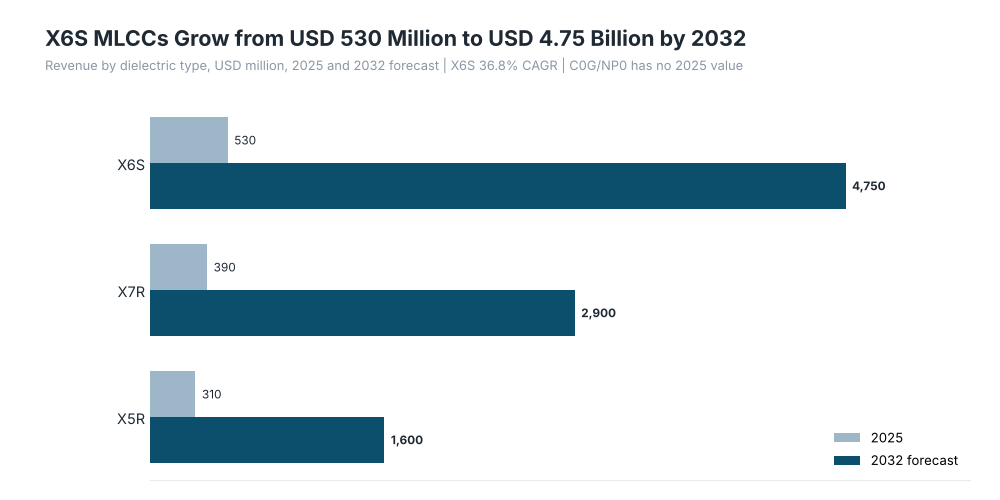
The X6S MLCC segment was valued at approximately USD 530 million in 2025 and is projected to reach USD 4.75 billion by 2032, expanding at a CAGR of 36.8%. Demand is concentrated in advanced GPU and ASIC accelerator platforms, where increasing capacitor requirements are supporting higher component sales. In July 2025, Murata Manufacturing began mass production of its 47 µF compact MLCCs, strengthening its product portfolio for AI servers and data centers. Samsung Electro-Mechanics is also expanding its high-capacitance offerings for AI infrastructure. Strong demand and limited qualified suppliers make X6S an important revenue opportunity for established MLCC manufacturers.
X7R MLCCs - Expanding Demand from AI Server Power Systems
The X7R MLCC segment generated an estimated USD 390 million in 2025 and is projected to reach USD 2.90 billion by 2032, growing at a CAGR of 33.2%. Demand is supported by investments in AI server power conversion and high-performance computing infrastructure. In September 2026, TDK introduced its 10 µF, 100 V X7R MLCC for applications including 48 V AI server power systems, offering twice the capacitance of its previous comparable product. The launch highlights opportunities for manufacturers supplying higher-value capacitors as AI server power requirements increase.
X5R and Specialized MLCCs - Demand from Supporting AI Server Components
The X5R MLCC segment was valued at approximately USD 310 million in 2025 and is projected to reach USD 1.60 billion by 2032, expanding at a CAGR of 26.4%. Demand is supported by power-management circuits, networking components, and supporting electronics used in AI servers. C0G/NP0 and other specialized MLCCs are expected to contribute approximately USD 1.02 billion by 2032, serving applications requiring stable and reliable electrical performance.
X6S and high-reliability X7R MLCCs offer stronger premium revenue opportunities, supported by increasing demand from advanced AI accelerators and server power systems. Manufacturers with qualified products, established customer relationships, and dependable production capacity are positioned to secure higher-value supply agreements.
Which Applications Generate the Highest AI Server MLCC Revenue?
GPU and ASIC Accelerator Boards - Largest Revenue Contributor
GPU and ASIC Accelerator Boards accounted for an estimated USD 700 million in 2025 and are projected to reach USD 5.35 billion by 2032, expanding at a CAGR of 33.7%. The segment's leadership is supported by increasing capacitor requirements across NVIDIA Blackwell and Vera Rubin, AMD Instinct, Google TPU, and AWS Trainium accelerator platforms. Higher investment in AI computing infrastructure and growing demand for high-capacitance MLCCs are creating substantial sales opportunities for suppliers serving advanced processor manufacturers.
Voltage Regulation and DC-DC Conversion - Fastest-Growing Application
Voltage Regulation and DC-DC Conversion applications generated approximately USD 190 million in 2025 and are projected to reach USD 1.85 billion by 2032, growing at a CAGR of 38.4%. The transition toward advanced AI server power systems is increasing demand for higher-value MLCCs. The segment highlights opportunities for capacitor manufacturers supplying next-generation data center power infrastructure.
CPU, Power Supply, and Supporting Electronics - Additional Revenue Opportunities
CPU and Motherboard applications are projected to reach approximately USD 1.25 billion by 2032, while Server Power Supply applications are expected to contribute USD 800 million. Memory, networking, and peripheral electronics collectively represent an additional USD 1.02 billion in projected revenue. These applications support MLCC demand across complete AI server systems, creating opportunities for established manufacturers serving motherboard suppliers, power equipment producers, and networking hardware companies.
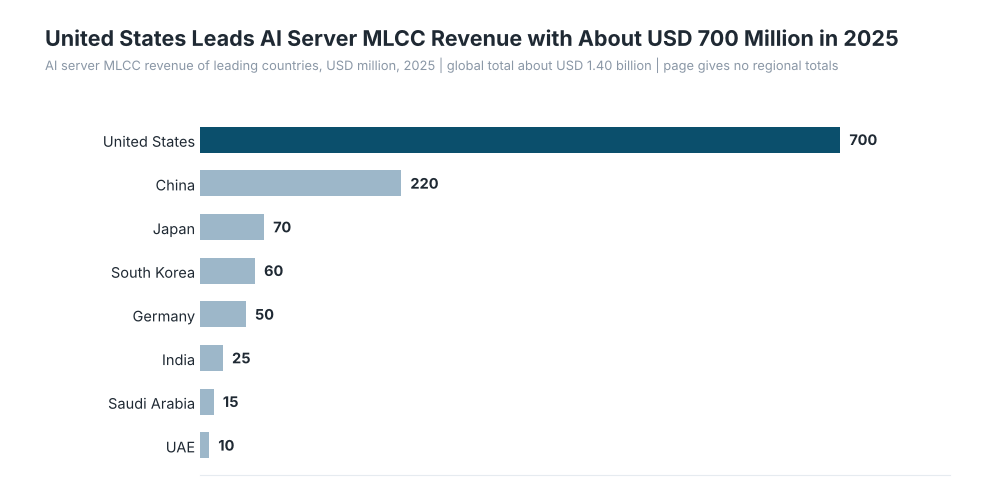
Which Countries Are Leading AI Server MLCC Demand?
United States - Largest Market for AI Server MLCCs
The United States AI Server MLCC Market was estimated at USD 700 million in 2025 and is projected to reach USD 5.00 billion by 2032, expanding at a CAGR of 32.4%. Demand is supported by substantial AI infrastructure investments from Microsoft, Amazon, Google, Meta, and Oracle. These companies are expanding GPU-based computing capacity and developing proprietary AI accelerators, increasing purchases of high-capacitance MLCCs through their server manufacturing partners. The concentration of leading AI chip developers and hyperscale cloud operators makes the United States an important market for advanced capacitor procurement and long-term supplier contracts.
China - AI Infrastructure Investment and Domestic Component Manufacturing
China's AI Server MLCC Market was estimated at USD 220 million in 2025 and is projected to reach USD 1.70 billion by 2032, growing at a CAGR of 33.9%. In February 2025, Alibaba announced plans to invest at least RMB 380 billion over three years in AI and cloud infrastructure. Investments by Tencent, ByteDance, and Baidu, alongside domestic AI accelerator development, are supporting demand for advanced electronic components. China also offers opportunities for domestic MLCC manufacturers as local server producers seek additional qualified suppliers, although Japanese and South Korean companies retain established strengths in premium capacitor categories.
Japan - Leading Manufacturing Center for Advanced MLCCs
Japan's domestic AI Server MLCC Market was estimated at USD 70 million in 2025 and is projected to reach USD 440 million by 2032, expanding at approximately 30.0% CAGR. Domestic demand is supported by AI computing infrastructure and advanced server installations. Japan's commercial importance also extends beyond domestic AI server deployments through component manufacturing and international supply. Increasing investment in high-performance computing provides opportunities for suppliers serving both domestic equipment requirements and overseas customers.
South Korea - Strong Position in High-Value MLCC Supply
South Korea's domestic AI Server MLCC Market was estimated at USD 60 million in 2025 and is projected to reach USD 440 million by 2032, growing at a CAGR of 32.9%. Demand is associated with domestic AI data center investment, semiconductor infrastructure, and advanced computing equipment. The country's established electronics manufacturing capabilities strengthen its participation in international AI server supply chains, while domestic MLCC consumption depends on accelerator deployments and server procurement.
Germany - Industrial AI Infrastructure Investment
Germany's AI Server MLCC Market was estimated at USD 50 million in 2025 and is projected to reach USD 360 million by 2032, expanding at a CAGR of 32.6%. In February 2026, Deutsche Telekom launched its Industrial AI Cloud in Munich, featuring nearly 10,000 NVIDIA Blackwell GPUs. The development reflects growing investment in dedicated AI computing for industrial and enterprise applications. Additional data center projects and accelerator procurement are expected to support demand for advanced MLCCs, particularly through international server equipment suppliers.
India - Rapid Expansion of GPU Computing Capacity
India's AI Server MLCC Market was estimated at USD 25 million in 2025 and is projected to reach USD 330 million by 2032, expanding at a CAGR of 44.6%. Under the IndiaAI Mission, shared computing capacity exceeded 45,000 GPUs by June 2026, reflecting government-backed investment in domestic AI infrastructure. Private data center expansion and increasing AI accelerator procurement provide additional opportunities. India's market potential is concentrated in server deployment and system integration, with capacitor demand linked to the number and configuration of AI systems installed.
Saudi Arabia - Large-Scale AI Accelerator Investment
Saudi Arabia's AI Server MLCC Market was estimated at USD 15 million in 2025 and is projected to reach USD 200 million by 2032, growing at a CAGR of 44.8%. HUMAIN and NVIDIA announced plans for AI computing infrastructure with potential capacity of 500 MW, including an initial deployment of approximately 18,000 NVIDIA GB300 GPUs. These planned investments represent a substantial opportunity for advanced MLCC suppliers serving accelerator and server manufacturers. Revenue realization will depend on project execution, hardware procurement, and completed installations.
United Arab Emirates - Emerging AI Data Center Market
The United Arab Emirates AI Server MLCC Market was estimated at USD 10 million in 2025 and is projected to reach USD 150 million by 2032, expanding at a CAGR of 47.2%. G42's Stargate UAE development includes an initial 200 MW AI infrastructure project within the broader planned 5 GW UAE–U.S. AI Campus in Abu Dhabi. The participation of NVIDIA, Oracle, and Cisco highlights international technology investment in the country's AI computing infrastructure. Future accelerator installations are expected to increase opportunities for MLCC suppliers, with actual demand determined by completed server deployments and equipment procurement.
Which Manufacturers Are Leading the AI Server MLCC Industry?
Samsung Electro-Mechanics - Leading Position in AI Server MLCC Supply
Samsung Electro-Mechanics reported more than 40% share of the global AI Server MLCC Market in September 2026. The company has established long-term agreements with more than ten global customers. Its strong position in high-capacitance MLCC manufacturing and growing AI infrastructure customer relationships support further expansion in premium server components.
Murata Manufacturing - Advanced MLCC Production and Manufacturing Expansion
Murata Manufacturing is a leading supplier of compact, high-capacitance MLCCs for AI servers and advanced electronic equipment. The company expanded production of specialized capacitors during 2025 and continued investing in manufacturing capacity, including its Izumo operations in Japan. Its established product portfolio and relationships with global electronics manufacturers strengthen its ability to secure supply contracts for next-generation AI accelerator platforms.
Taiyo Yuden - Higher MLCC Content Expands Revenue Opportunities
Taiyo Yuden expects AI server MLCC demand to grow at approximately 32% annually between FY2025 and FY2030, compared with 5% annual growth in AI server production. According to its Annual Report 2026, the company anticipates more than doubling the number of MLCCs used per AI server during this period. Its investment in compact, high-capacitance, and embedded capacitor products supports opportunities in advanced accelerator systems and high-value component supply.
TDK - Expanding High-Voltage MLCC Portfolio for AI Servers
TDK is strengthening its position in AI server power systems through specialized high-capacitance products. Its portfolio targets applications including 48 V AI server power systems and provides opportunities for TDK to expand sales to data center equipment manufacturers seeking higher-performance power components.
Yageo, Kyocera, and Other Suppliers - Competition in Server Electronics
Yageo, Kyocera, Walsin Technology, and Chaozhou Three-Circle participate in the broader MLCC supply market, serving industrial electronics, power systems, and computing equipment. Their product portfolios provide opportunities in AI server motherboards, networking hardware, and supporting electronics. Expansion into premium accelerator applications will depend on customer qualification, manufacturing capabilities, and the ability to supply advanced MLCC products at commercial scale.
Which Technologies Could Change AI Server MLCC Demand?
Embedded Capacitors - Opportunities in Advanced Accelerator Packaging
Embedded capacitors are gaining relevance in advanced AI accelerator development, particularly as manufacturers seek more compact power systems. Their adoption could expand opportunities for specialized capacitor suppliers while changing the mix of components purchased for future accelerator designs.
Silicon Capacitors - Growing Investment in Alternative Capacitor Technologies
Silicon capacitors represent an additional opportunity in advanced AI semiconductor packaging. In May 2026, Samsung Electro-Mechanics announced a KRW 1.5 trillion silicon capacitor supply agreement covering 2027–2028. The contract demonstrates commercial investment in capacitors used within high-performance semiconductor packages, including AI GPUs and high-bandwidth memory. Silicon capacitors may increasingly complement MLCCs in selected applications, influencing future component procurement and supplier investment.
How Are Raw Material Supply and Manufacturing Capacity Affecting Competition?
Advanced MLCC manufacturing capacity is becoming an important competitive advantage in the AI server market. According to TrendForce, production challenges involving high-capacitance X6S components have contributed to supply constraints and longer delivery periods. Manufacturers with established ceramic material expertise, consistent production quality, and qualified manufacturing facilities are better positioned to secure orders from AI accelerator and server manufacturers.
Competition increasingly depends on reliable high-volume production, customer approvals, and the ability to meet large supply commitments, rather than access to raw materials alone. Established suppliers are expanding their advanced capacitor capabilities to serve AI infrastructure customers, while newer competitors face the challenge of achieving consistent production quality and qualification for premium accelerator applications.
Analyst Commentary
The AI Server MLCC Market is becoming increasingly concentrated in high-value components, where advanced manufacturing capability matters more than overall production scale. We expect Samsung Electro-Mechanics, Murata and Taiyo Yuden to retain a strong competitive advantage, particularly in compact, high-capacitance X6S products. The growing use of custom AI accelerators should create additional opportunities, although tighter customer qualification and long-term supply agreements may make market entry difficult for smaller manufacturers. The key industry risk is that higher-capacitance designs and alternative capacitor technologies could reduce component quantities in future server platforms. Growing pricing pressure could also challenge established suppliers' market positions through 2032.